Why Drawing is Hard: Visual Limitations and the Skills to Overcome Them
If asked to draw a picture of a tree or a person in front of them, many people would say “I cannot draw.” Thirty years ago, two psychologists pointed out that this should be surprising. They reasoned that most people can trace over pictures easily, and most people can perceive the world accurately. So why can’t most people look at the world, perceive it, and then draw what they perceive?
Since then, researchers have extensively studied which aspects of perceptual and other skills seem correlated with improved skill at drawing, but have yet to form clear explanations for why drawing from life is hard.
In a new review paper, Judy Fan and I propose a new way to understand how people draw from life, and why it is hard:
| A. Hertzmann, J. E. Fan. Artists’ Drawing Strategies Serve to Overcome Visual Processing Limitations. Psychology of Aesthetics, Creativity, and the Arts. 2026 (Advance online publication). [Preprint] [Official version]] |
In the paper, we argue that drawing is hard because we humans have very limited vision and memory—much more limited than we think. We just don’t perceive the world as a picture. And so, learning to draw realistic pictures is not about innate talent, it’s about learning skills to bypass these visual limitations that we all share.
One important caveat: this blog post is about just one aspect of drawing: transferring information from what you see to the page, as in copying an existing drawing. We study copying because it isolates some crucial aspects of realistic drawing skill. But drawing pictures isn’t just copying, for lots of reasons. Our paper does survey some other aspects of drawing, and I’ve also written elsewhere about them, including perspective, choice of subject, picking which lines to draw, abstraction, creativity, speed and sketching, taking risks, and the role of different choices along the way.
Our visual limitations
One might think that an artist looks at the world, and then draws their mental picture. But no one can draw accurate pictures this way. We do not see entire scenes this way, and we do not store complete, pixel-level pictures in our heads.
Human vision is severely limited, both in terms of what we see at any moment, and how much of it we remember, even over short periods of time. And, these limitations are not obvious—we are unaware of how much we do not see, until it is pointed out.
As an example, suppose you wanted to draw a picture of this houseplant.

Try looking at the picture, and then looking away from it. How many details do you remember when you look away: how many branches does the plant have? How many leaves does each branch have? Generally speaking, these questions are easy to answer when looking at the picture, but nearly impossible once you’ve looked away. Once you look away, the information is gone from your head. And getting the fine details purely from memory—the curvature of the stems, the precise outlines and shading on the leaves: definitely not possible.
If you were to try to draw the picture from memory, you’d be making a lot of it up, based on what you know about what plants look like.
This demonstrates the first important limitation of human vision: we remember almost no fine visual details. We don’t store pictures in our heads like they were JPEGs. We do remember things about the pictures we’ve seen, but not at the level of detail necessary to accurately draw them.
Here’s the second thing to try: stare at one leaf on the plant, and then, without moving your eye from that leaf, try to answer those questions again (how many branches? How many leaves?). Again, if you fixate your eyes only one spot on the plant, then you get very little detail about the rest of the plant. Again, you couldn’t draw an accurate picture of the plant just staring at one leaf.
This demonstrates this second important limitation of human vision: we get very little detail in peripheral vision, that is, in directions that we’re not looking. As another demonstration, try staring at one word in this paragraph, and, without moving your eyes, see how many other words you can read. The answer will be almost none.
Moreover, not only do we see and remember very little, we’re really unaware of this; we tend to think that we’re seeing everything in front of our eyes, but this is an illusion. I’ve written much more about this illusion and provided surprising demonstrations about at that link. I have also written about how these illusions determine how we use and perceive perspective in pictures.
Once we understand these limitations of human vision, then a whole lot of things about how people draw begin to make sense.
Eye movements in drawing
| “When you draw from the eye, you’re drawing from memory. A memory of five seconds ago, a memory of ten seconds ago, a memory of a minute ago.” —David Hockney |
Here’s Henri Matisse drawing a picture of his grandson. He doesn’t just look at his grandson once and then draw from memory. Instead, watch how much he moves his eyes back and forth between the drawing and his grandson:
What exactly are his eyes doing?
Here’s another video of a person copying a picture, but this time recorded with an eye tracking device. The black rectangle show where the his eyes are looking at any moment.
The artist’s eyes are continually going back and forth between lines in the drawing and the lines in their copy. In both videos we see that drawing from observation involves near-continual eye movement between the source and the drawing.
Why? Given the limitations of human vision that I demonstrated above make it obvious. Consider just copying a drawing. If the brain can store only very little detail at a time, then you can’t remember a detailed version of the source picture or your copy. You continually moving your eyes back-and-forth to gather information from the source and then see where to put it in the target. It’s a bit like trying to transfer water between two pots using only a leaky teacup.
What happens if you restrict eye movements? One common drawing exercise is called “blind drawing,” in which you are not allowed to look at your drawing, only your subject. Here’s an example of a blind drawing that I made at a workshop, where we were given 30 seconds to draw the person next to us using a single line:
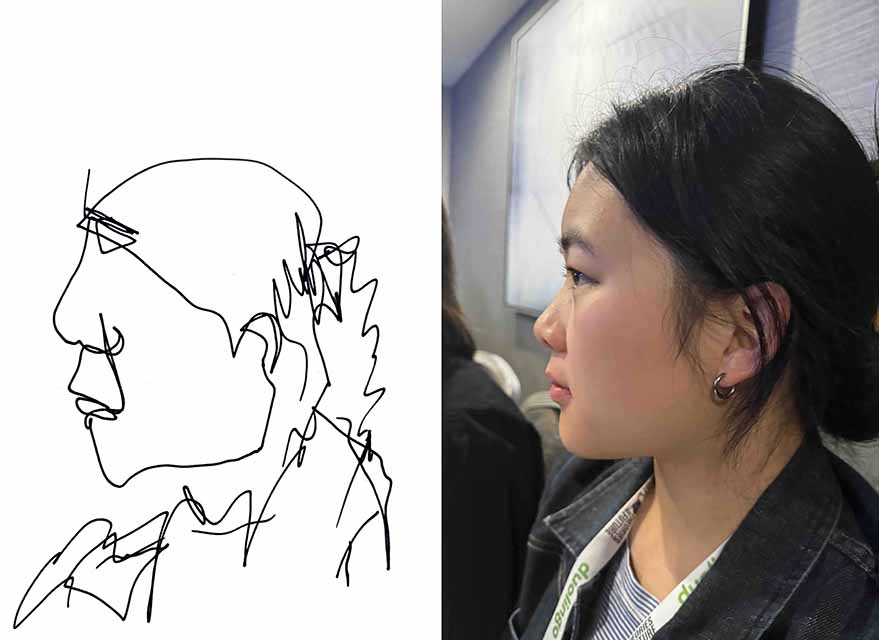
(I took the photo a moment later.) The “errors” are typical of blind drawing: individual shapes are accurate, but their relative proportions and positions are way off. I drew her eyes, nose, and jawline first, then her hairline, but, by the time I got to the hairline, I didn’t know where my pen was relative to the her nose and eyes, and so I put her hairline right over her eyes.
When trying to do life drawings for the first time, beginners tend not to look at the source very much; they spend most of the time looking at their drawing. As a result, they can’t get many details very accurately simply because they never see them. One study found that requiring novices to look at the subject more frequently improved their copying accuracy. Blind drawing is also an exercise often giving to beginner students.
Learning to draw, as they say, is partly about learning to look, and, to start, that can simply mean spending more time looking.
Drawing is a set of skills
Everyone shares these visual limitations. Learning to draw is a matter of learning skills to work within these constraints. Artists develop a range of different techniques, strategies and skills for all parts of the drawing process. Here are just a few examples.
To draw simple lines and curves, the “target locking” technique for drawing an individual line is to position your pencil at the start of the lines, fixate your eyes on the end of the line, and then draw to where you fixate:
Nobody teaches you to do Target Locking, and nobody does it intentionally. In fact, almost no one knows about it, even if they do it all the time. Target Locking is a description of behaviors observed in a few eye-tracking studies. People are not good at being very aware of how their eye movements operate. (Another behavior, from the same study, is “smooth pursuit,” where the eyes follow the pencil.)
When I read about ways that artists use coordinated eye and hand motions simultaneously in copying, I wondered if I drew that way. So I tried drawing a sketch at my desk, and—indeed—I was moving my eyes and hands in parallel just as they described. Before then, I’d had no idea.
A more high-level example. Here’s a simple fact: a person’s eyes are half-way between the top and the bottom of their head. Yet, often our drawings don’t come out that way. Here’s a sketch that I recently drew for a paper figure:
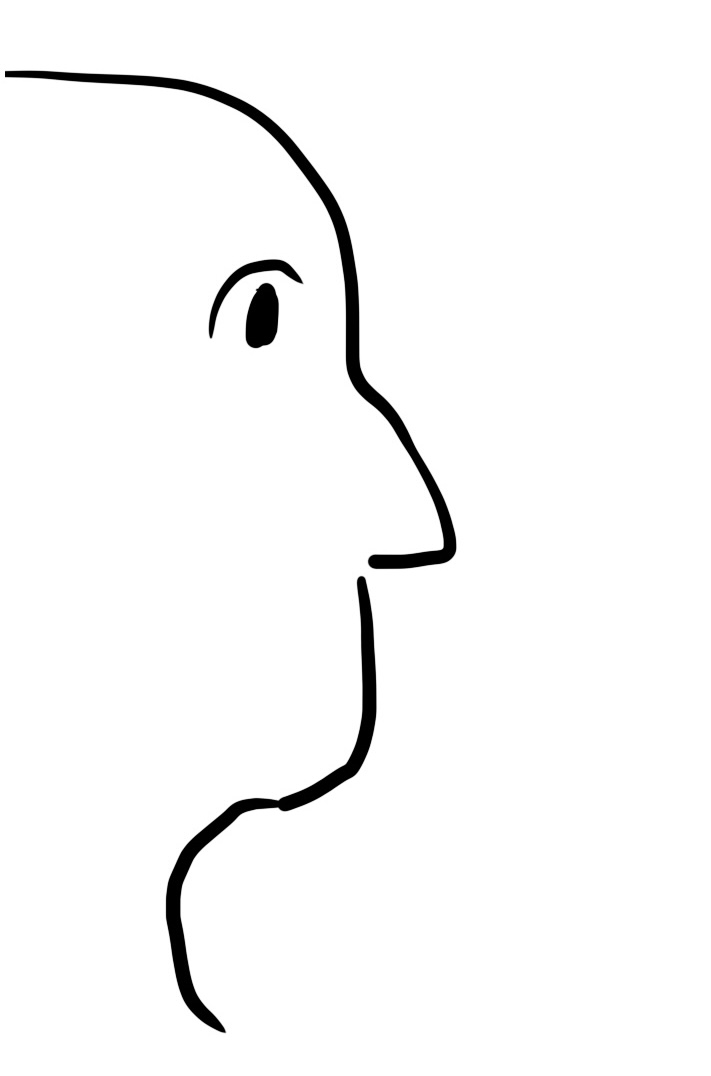
There are a few things to point out here:
- The cartoon character’s eyes are almost next to the top of his head, which would look totally wrong in real life.
- You might not notice this anatomical mistake in the cartoon unless it is pointed out.
- I know this anatomical fact, and yet I still made the mistake.
- I don’t care about the mistake; I’m perfectly happy with this cartoon. I don’t consider it a mistake; I think the cartoon looks fine without anatomical accuracy.
- But if this were part of an initial sketch for a more-accurate drawing, then this would be a problem, and one might not notice the problem until much later.
This knowledge can be useful for drawing: one study found that informing novices that the eyes are in the middle of the head improved their drawing accuracy. This conceptual knowledge can help you make conscious judgements to improve your drawing. This is why realistic artists sometimes engage in careful studies of anatomy.
Here’s an explicit technique that you can use to draw faces and avoid this problem. First, draw an oval for the head, then a cross to indicate gaze direction, like in these examples:
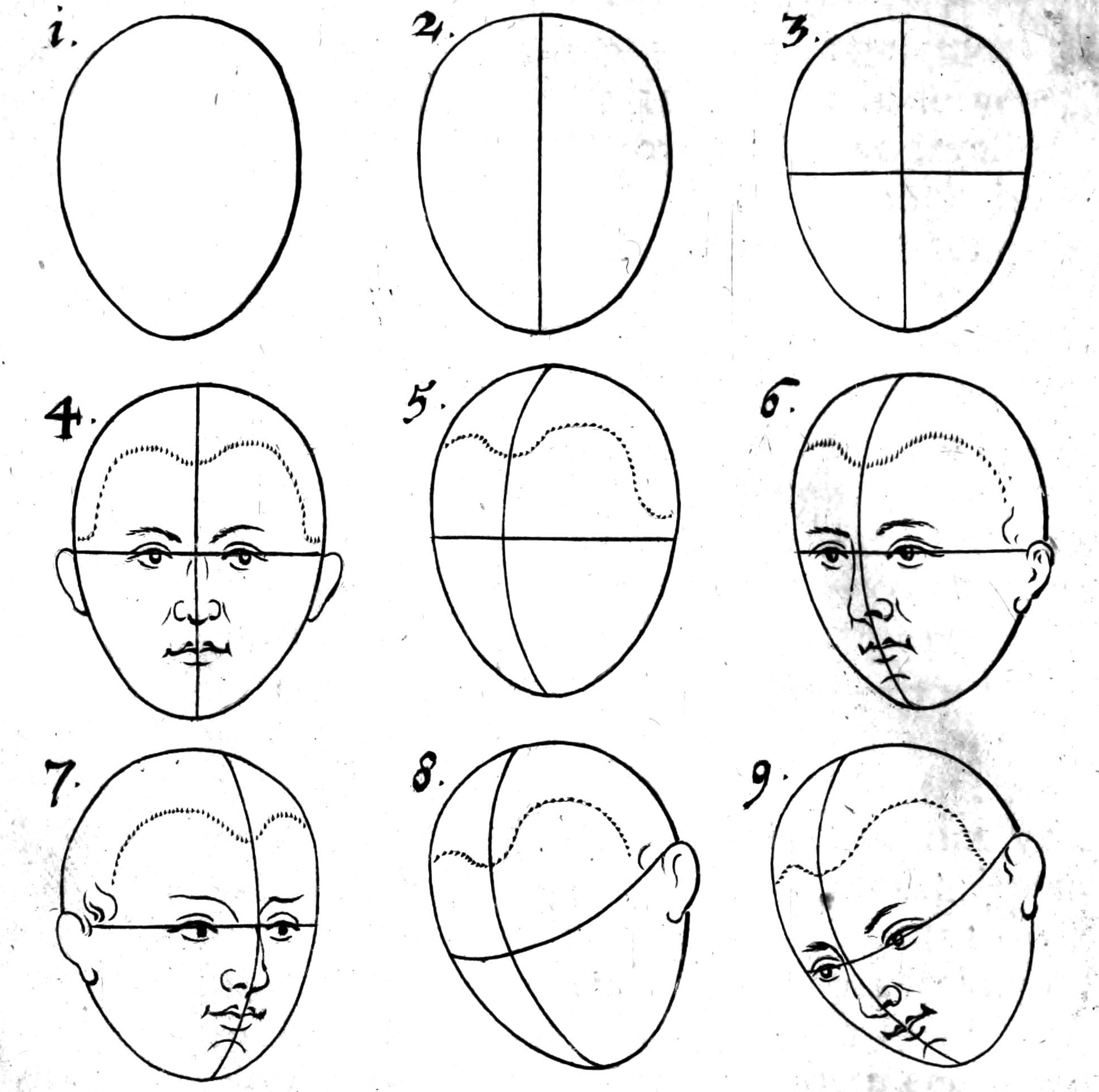
People have created all sorts of more-elaborate such rules for other kinds of drawing, including one-point perspective and two-point perspective, and rules for drawing full bodies, which has led to some great parodies.
In the paper we survey many other kinds of strategies and skills that artists learn.
Anyone can learn to draw
In Western culture, we’re taught that artists are some sort of special geniuses with innate talent—you’re either an artist or you’re not—a belief that only dates back to 18th-century Romanticism and misguided educational philosophies.
This mystical nonsense prevents people from learning to draw. But all you have to do is take a chance and try it out. I personally have known so many people who took a drawing class or worked from a book of exercises and went from “I can’t draw” to “Wow, I drew that?”
Our work suggests some reasons why people might mistake the inherent difficulty of drawing with innate lack of talent. We’re unaware of how limited our own vision and visual memory is. So it’s like there’s this invisible mental block—limitations of vision and the illusion of awareness—and we think that it means “I’m not good.” But simple exercises can help you start to work around this mental block. Once you understand the block, it makes more sense.
Drawing is a skill you learn, not an innate talent. I think there are only a few things you need to learn to draw: a little bravery, some exercises (especially from a book or from classes), and lots and lots of practice. I wrote a little more about this here. Just a little time and practice can make drawing an engrossing pursuit that enriches your life and becomes its own reward.