The Brain Is Not Just A Computer, and Cannot Be Simulated by One
Over the past eight years, I’ve given many talks to computer science audiences, arguing that computers will not be considered artists. And very often at least one person says that I’m wrong, because:
- The human brain is just a computer, or
- A human brain can be simulated in a computer, by simulating the physics of the world,
and so computers can be artists.
This is about more than art—it’s about all of “AI”. If the brain is just a computer, then it follows that we can someday build computers with human-like intelligence and consciousness… and maybe we already have. If, on the other hand, the brain is fundamentally not a computer, then that makes “intelligent AI” or “conscious AI” far more speculative. Philosophers and neuroscientists have long argued over this question, but recent developments give it a moral urgency.
These opinions seem deeply held; one computer scientist accused me of being a creationist simply because I said there’s some important difference between human brains and computers.
In this blog post, I explain why the brain is not merely a computer, and cannot be simulated by computers. By “computer,” I mean digital computer, like the ones that we all use so much of the time. Digital computers are human-made systems that perform fixed logical operations on rigid clock cycles, with meaningful abstraction layers across scales. Human brains are biological systems integrating electrical, chemical, protein, and fluid interactions, with unimaginable complexity over literally billions of neurons and other types of cells, involving continuous-time continuum mechanics, across scales from the subatomic to the visible.
(Note: I wrote a previous blog post on this topic; this is a complementary take.)
The brain is like a computer
Treating the brain as a computer has yielded profound insights across cognitive science and computational neuroscience, including the ability of computer vision models to model visual cortex activations or the way that reinforcement learning theory can describe the dopamine reward system. David Marr’s proposed computational modularization of human vision inspired generations of scientists.
Theoretical computer science defines a computer as “something that can compute functions that a Turing machine can compute.” Richards and Lillicrap point out that, according to this definition, the human brain is literally a computer, because, with pencil and paper, a person can work out the steps of any calculation that a computer can.
One argument we often hear is: brains are enormously complex and hard to understand, but so are artificial neural networks. So it makes sense that they could model the brain. But just because two things are complicated does not mean they are the same. Personal relationships are complicated, and quantum mechanics is complicated, but that doesn’t mean they are anything like each other or like the brain. These things are all complex in totally different ways.
Regardless, none of this shows that the brain is just a computer.
Real computers use digital logic, unlike brains
The word “computer” can mean a few different things in different contexts. This blog post is about real computers that we can build. It is not about theoretical computers, nor about hypothetical science fiction computers. If we allow for science fiction computers, then literally anything is possible. Most of us care about what is actually possible in the real world that we live in, this year or in five years, not in the year 3000.
Real computers—the things we actually build, the one that I’m writing this on, and the one that you’re probably reading this on—are based on digital calculations. All data is converted to digital information (0’s and 1’s), and processed using logical calculation, either with logical circuits embedded in silicon, or, indirectly through stored programs that determine processing logic. A CPU or GPU operates in a fixed clock cycle, where each logical operation on the circuit happens in sync with all the others; multiple CPUs used together may each have their own clock cycles.
A foundational ideas of computing is to separate what a computer computes from how it computes it; computers are engineered into cleanly-separable abstraction layers across scales. You can run the same software on different operating systems; you can run the same operating systems on different physical computers; you can implement the same digital logic systems with different kinds of electrical systems, whether silicon transistors or vacuum tubes; a person could even work through the calculations by hand with pencil and paper. You can write emulators that perfectly simulate old computer systems in new ones. Modern silicon designs are staggeringly complex, but their modular designs allow teams of engineers to create them.
A brain is formed of flesh and blood, proteins and chemicals, and is an inseparable part of a biological, living organism. It lacks binary logic bits, fixed clock cycles, or stored programs. The brain is obviously not a digital computer.
It could be that the brain is some other kind of non-digital computer, but, as we will see, that framing would be very misleading.
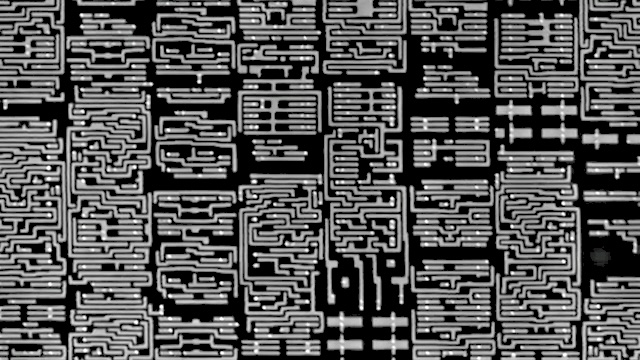
The mind-boggling complexity of brains
Before going further, let’s go slightly deeper into what we know about how brains work.
The brain has an enormous number of mechanisms, and all of them interact with each other in complex ways, from blood flow to electrical connections to chemical signaling to electromagnetic waves and more. And these complexities operate across scales that all interact.
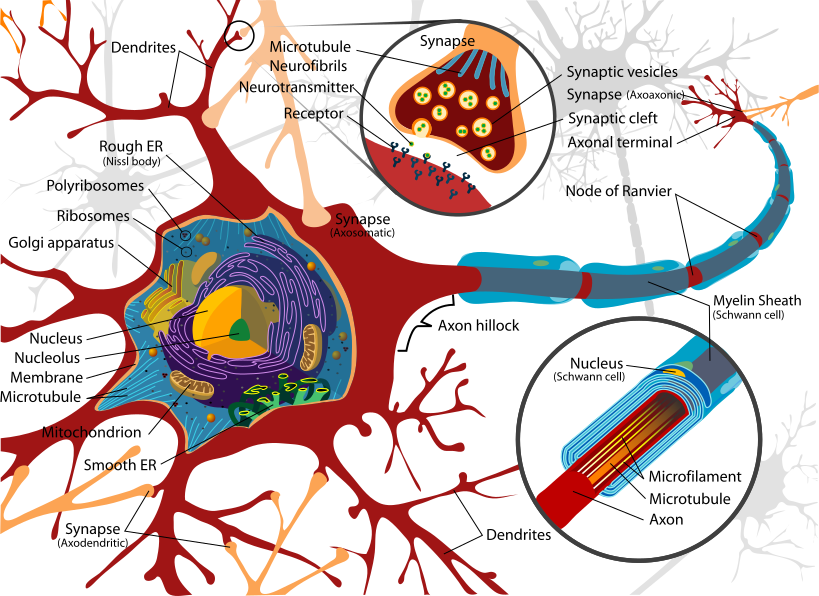
Biological neurons are cells that receive and transmitting signals. Neurons exist in a “chemical soup” and their outputs depend on an enormous number of physical, electrical, and biochemical factors: the physical shape of the individual cell; the cell’s recent history; tens of thousands of ion channels (biochemical receptors on the cell surface, which can have hundreds of distinct electrical and chemical behaviors); chemical signalling (such as diffusion of nitric oxide synthesized in blood vessels, diffusing in the brain, and affecting signalling between neurons); physical forces between neurons; local temperature fluctuations (which can affect brain firing frequency); the collective electrical field produced by neurons, affecting their firing; numerous other kinds of cells, like glia which affect synaptic transmission for nearby neurons; blood flow that transmits signalling molecules from other parts of the body.
We keep discovering new mechanisms that add enormous complexity to our understanding of what a single neuron even does. One recent study found that dendrites store information and make predictions independent of the rest of a neuron. Neuronal spiking helps self-regulate and prevent build-up of harmful chemicals. Some speculative theories even suggest a role for quantum mechanics.
In contrast, a digital logic gate in a computer implements one operation, like AND or XOR. An “artificial neuron,” as commonly implemented, is a weighted sum of numbers, followed by a nonlinearity, such as setting negative numbers to zero. Modern “AI” is largely based on a single mechanism, for which a sixth-grader could do the calculation.
In short, a brain involves electrical signalling, chemical signalling, proteins, blood flow, electromagnetic fields, with thousands and thousands of different types of mechanisms, all continually operating together across multiple scales from the visible to subatomic particles, without digital logic or clock cycles. Brains do it all on a steady 20 watts of power, much less than a typical laptop.
Unlike digital computers, brains do not have abstraction layers. In the words of neuroscientist Anil Seth, there is no distinction between wetware and mindware: “it is hard and perhaps impossible to separate what they do from what they are.”
My description here is primarily based on an excellent paper by neuroscientist-philosopher Rosa Cao; see that paper for a much more in-depth discussion of these issues and their philosophical implications.

Is the brain some other kind of computer?
Ok, then, if the brain is not a computer, then what kind of thing is it? Isn’t the answer going to end up just being some other kind of computer?
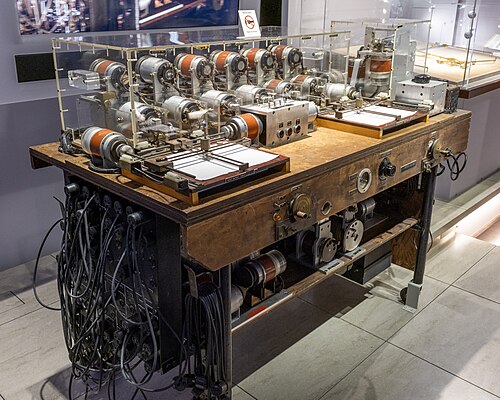
It does seem reasonable to say that “the brain is an analog computer.” Its job is to take sensory input (information) and produce behavioral signals: information in and information out. But this downplays just how profoundly different a brain is from anything that we can fully understand. We do have historical analog computers for relatively simple calculations, like slide rules and differential analyzers, made obsolete by digital computers.
Moreover, there are some theories that the non-computational nature of brains is essential to consciousness, for example, Ned Block’s argument that chemical signaling is more important than neural signaling, and, perhaps, essential for consciousness. There are so many mechanisms that we barely understand in the brain, if at all.
There’s not much value in saying that brains are analog computers, because we have no useful, relevant theory for analog computing. The brain is nothing like a slide rule. Moreover, it would be profoundly misleading, because it sounds like a version of “the brain is just a digital computer.”
We don’t have a useful, comprehensive metaphor or model for what a brain is. A brain is just a brain.
We cannot accurately simulate brains
Could we accurately simulate a brain?
Simulation requires us to know the relevant variables of a system and the physics of the system, and it requires sufficient computational power to perform this simulation. Each of these pieces presents, on their own, an insurmountable barrier to accurate simulation.
The human brain has 86,000,000,000 neurons, each of which averages 7,000 synaptic connections to other neurons, along with tens of thousands of ion channels on each neuron. These neurons have countless other interactions and mechanisms, many surely yet to be discovered. It is unclear if we will ever fully know all of the mechanisms. And, our supercomputers struggle to simulate much, much simpler systems accurately.
One might think we could abstract out some elements of the system. We don’t need to know where every nitric oxide molecule is. Perhaps we could approximate the behaviors of individual neurons, or simulate multiple neurons on some abstracted level. But such approximations will likely lose important information; the joint behavior of two neurons is likely to be combinatorially more complex than a single neuron alone. Moreover, Cao argues that the function of neurons may be intimately tied to their physics by the principle of “generative entrenchment,” so that simplifying their behavior loses important mechanisms. Neurons lack the conceptual modularity that we’re used to in digital computers.
There are indeed attempts to simulate brains, such as a recent supercomputer simulation of the mouse brain. But this simulation abstracts out many of the specifics and details that I’ve mentioned, while also lacking an interface to the rest of the body, and, while this research sounds useful, it seems unlikely that it will be able to truly simulate human thought or behavior any more than an LLM can.
Suppose I asked you to multiply a billion times a billion, by writing a billion tickmarks out on a piece of paper, one billion times. In theory, you could do it. None of it is theoretically or conceptually difficult. However, if each tick took a second, this would take you 32 billion years. So you can’t actually do it this way. It’s theoretically possible but not actually possible. And the fact that it’s theoretically possible is irrelevant to any further discussion; you couldn’t try to understand how the tax office works if you believed that all the accountants used tickmark arithmetic.
Likewise, it might be theoretically possible to simulate a brain, if we had a complete understanding of the underlying physics, chemistry, and neuroscience. But it might also require a supercomputer the size of a solar system. If so, it’s not actually possible to simulate it.
Anyone who has worked on physical simulation knows that it is much, much harder than it sounds. Just knowing the physics of a system and the state of a system is not enough. Tiny, tiny errors always magnify, and errors are a necessary part of simulation on digital computers, which cannot represent real numbers with infinite precision. People performing physical simulation typically navigate tradeoffs of speed and accuracy: you can make a fluid simulation for a movie that looks great, but it won’t obey real physical properties, or you can make a physically-accurate simulation of ocean waves that takes weeks to run and only captures a few cubic meters of water.
Fully simulating a truly complex system, like weather patterns, remains impossible. We can simulate the weather in aggregate, and we can make average predictions about the weather—just like we can with human behavior—but truly accurate simulation is beyond human reach even with massive supercomputers. As we all know from experience, no weather prediction is perfect.

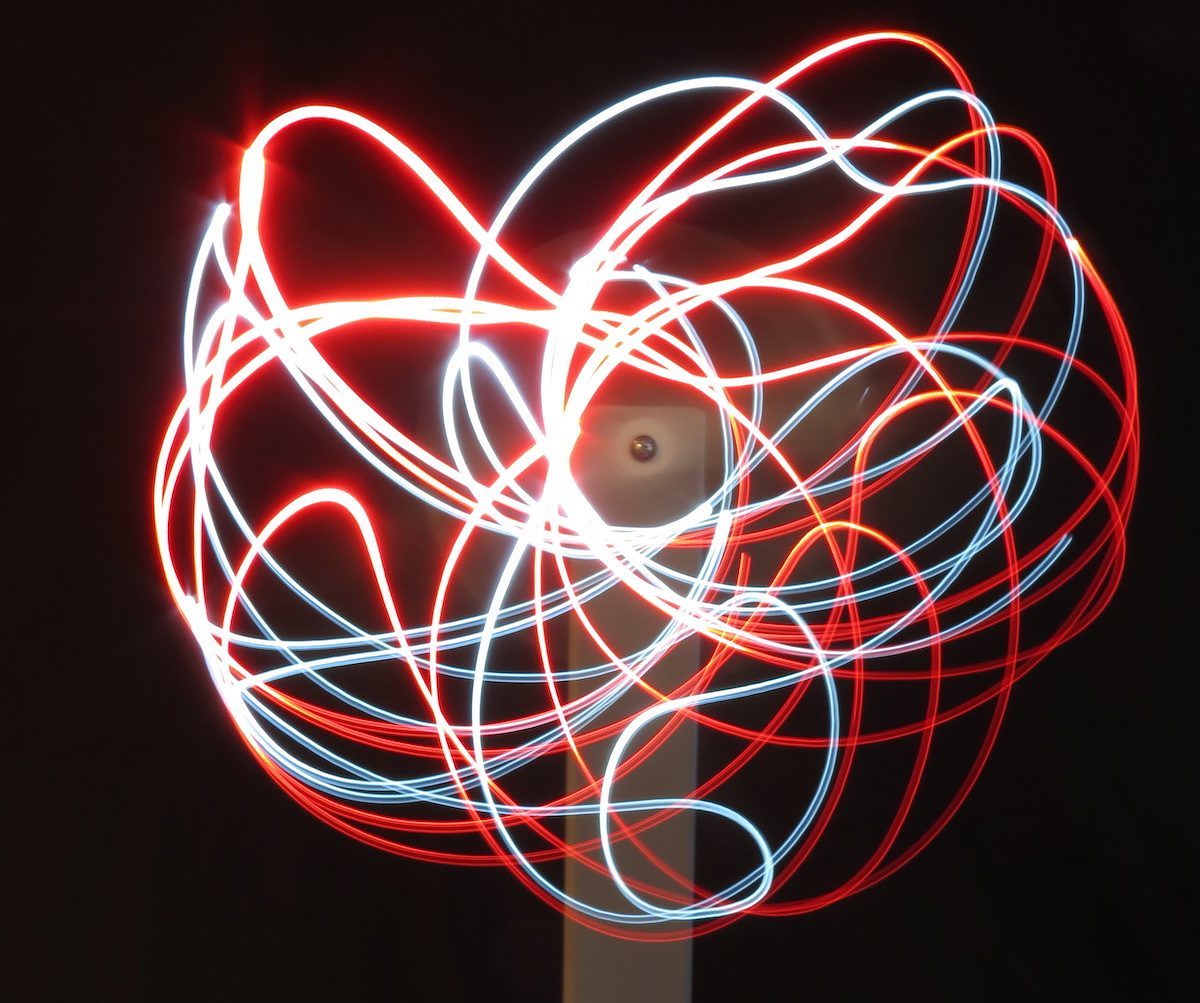
The situation is even worse for chaotic systems. Even very simple physical systems, like a simple double pendulum, can exhibit wildly varying behavior that quickly makes it unpredictable. Tiny numerical errors magnify so that accurate simulation would require enormous computing resources. And this is just for systems of two or three variables. A major element (and the title) of The Three-Body Problem derives from the fundamental unpredictability of chaotic systems.
The brain is an enormous complex dynamical system of uncountably many variables (i.e., continuous fields, not just discrete variables), involving electrical, fluid, and chemical mechanics, with complex feedback affecting neural function, likely with many chaotic elements.
Even if we somehow had a perfect simulator, the problem of determining initial conditions seems insurmountable. Producing valid behavior requires knowing the state of the system at some point in time. We can’t just boot up a brain from a raw install the way we can with a computer. Brains develop from fetuses through gestation in a complex biological process; the problem of initial conditions prevents simulating even a newborn baby’s brain.
Outside of science fiction, accurate, precisely-detailed simulation of the brain is simply impossible.
The differences matter
Neuroscientists and philosophers have long debated the relationship between brains and computers. Academically, it’s an interesting and important question.
However, the growth of “AI” companies create a new moral urgency. Treating brains as “just computers” risks either dehumanizing people, giving false moral weight to computers, or both. Either could be very harmful for society.
Here’s an example. One recent news story quotes billionaire owners describing people as “meat computers.” To my ear, this description devalues people, since neither meat nor computers have any moral rights or value. It suggests that they don’t think we have human rights, any more than a T-bone steak does.
When I give talks, some people seem so insistent that people are just computers, and so I’ve searched for a way to simplify the point, which I do with this slide. Here’s a computer, me, and my dog:
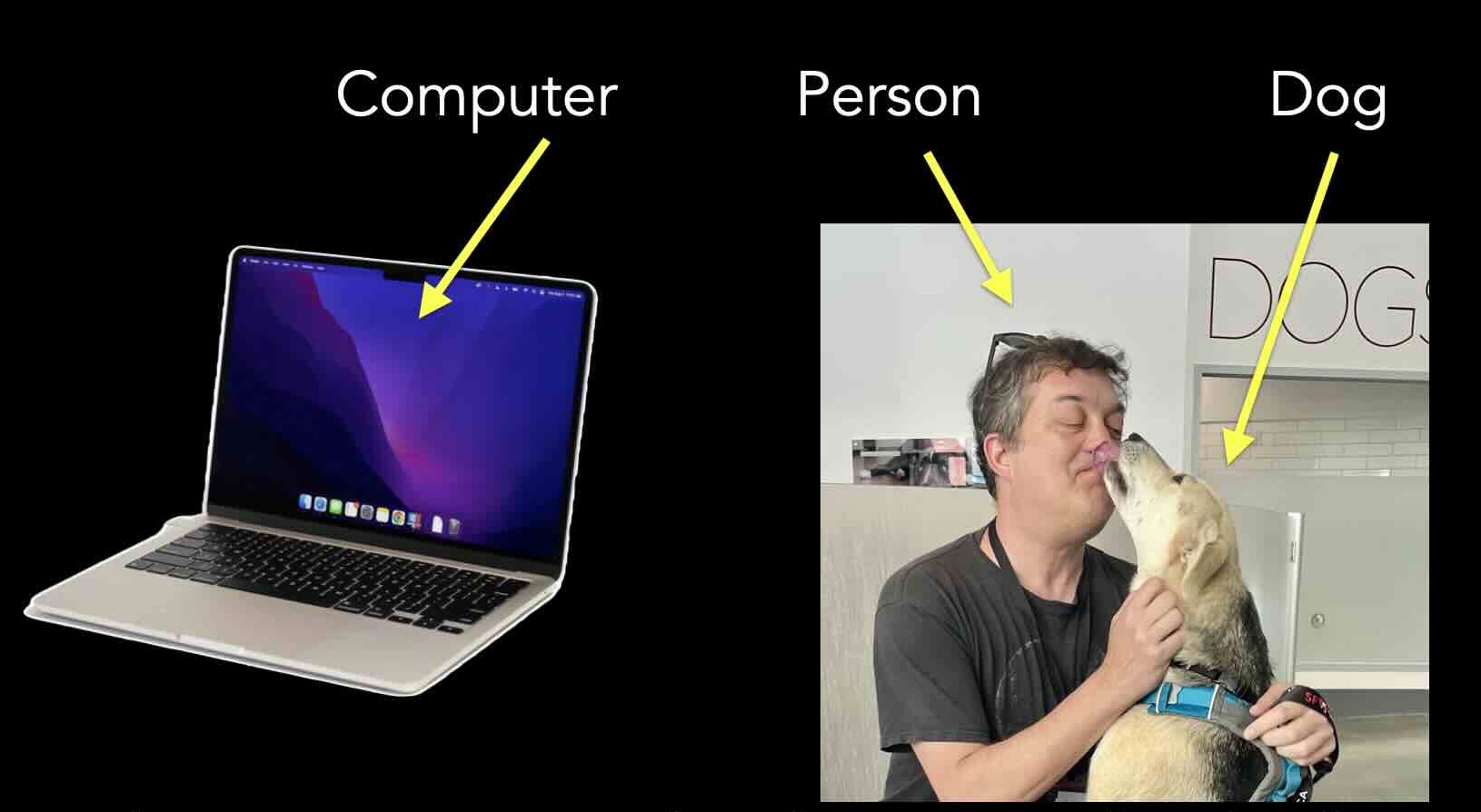
When my computer grows old and unreliable, or simply cannot run the latest software, I will wipe its memory and recycle or discard it. But I cannot do this with other people or with dogs. Even though my dog cannot generate code or write sonnets in the style of Shakespeare, but she carries some intrinsic moral weight and value. Even if I somehow grow tired of her, or she grows old and infirm, I cannot just dispose of her the way I would a computer.