Dogs Do Not Know Things
| “On a bench one afternoon in a grassy park in Minneapolis, I realized what I liked best about the dogs of Minneapolis is that they have no idea that they’re in Minneapolis.” —Billy Collins, In Praise of Ignorance |
When you spend time with a dog, you have some ideas about what’s going on in its head. You get a sense of its moods, whether it is happy or tired or afraid. Taking care of a dog, or training it requires you consider its moods and its needs. Naturally, we understand their expressions to our own, and we often talk about our dogs like they’re our children, to be nutured and guided and trained. But, sometimes, these human analogies mislead us.
Specifically, we often describe dog behaviors in terms of knowledge. “She knows that if she sits, she gets a treat.” “He knows he’s not supposed to be on the couch.” “To deal with separation anxiety, she has to know you’ll come back.”
In this blog post, I’ll explain why I believe that dogs do not know things, not in the way that we do. If dogs had knowledge the way we do, they ought to be able to perform some kind of conceptual reasoning or planning. But they do not exhibit any behaviors that require conceptual knowledge. Importantly, dogs do not know about the future, and so they cannot plan for the future either. I’ll talk about what kinds of intelligence dogs do have, and how these can be mistaken for knowledge.
Much of the time, talking about dogs as if they have knowledge or planning ability is simply a convenient shorthand. But misunderstanding dog psychology can lead to bad experiences and poor relationships with them. Conversely, better understanding of dogs can make us more empathetic toward them, strengthening our bonds.
I am not an expert; this is just my interpretation based on my experiences and the books I’ve read on dog training. (For a cognitive psychology take, see this thread responding to this post.)
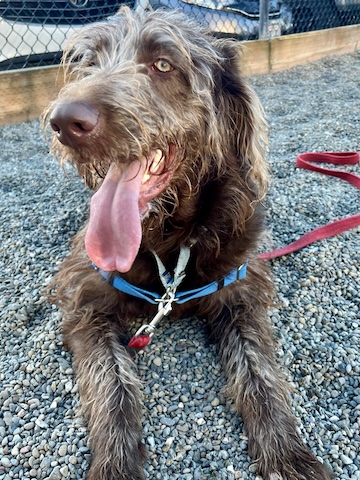
This post is decorated with photos of dogs that I’ve worked with at the San Francisco SPCA, and my own rescue from the shelter. (The photos on my phone are like 80% dogs.)

Dog intelligence
Here are some kinds of intelligence we see in dogs, and the behaviors that go along with them.
Dogs learn from reinforcement. If you have ever worked on dog training, then you’re familiar with their ability to learn from reinforcement (classical conditioning and operant conditioning). If they do something and get a reward (anything positive that they like), they will tend to do that thing more often. So we give positive reinforcement for desired behaviors.
Suppose a dog has been trained to sit when you say “sit,” and, sometimes you do this, you give them a treat. This is a learned behavior: saying the command “sit” triggers the dog’s “sit” behavior. When the training is solid enough, the dog does the behavior automatically.
Unrewarded behaviors tend to decrease, so we try not to reward unwanted behaviors (this can be difficult, like when your dog jumps on you for attention). Negative reinforcement also reduces unwanted behaviors, but it creates other problems, so it should be avoided.

Dogs form associations. Some associations are innate (my dog loves delicious-smelling things), while other associations are learned (she loves the dog park, so she pulls toward it when we’re near). Some associations can be more specific: my dog goes to the food bowl when she’s hungry. Some spaces are safe: a dog that is scared may try to retreat to a space where they feel safer.
Negative associations can be formed with positive things. When I first started trying to train my dog to relax when I left her home alone, I tried giving her delicious dental chews whenever I left. But instead she learned to associate the chew with her isolation anxiety. Now when I give her a chew and stay home, the poor girl alternates between eagerly running away to chew on the toy, whimpering pathetically, and running back to check that I haven’t left her. (I now believe that she had some abandonment trauma from her previous owner, given what I know.)

Dogs have some spatial awareness; one might call it a specialized spatial knowledge: my dog knows her way around our apartment and many other places. When we visit a friend’s house, she’s visibly excited to be on the doorstep and eager to get inside, seemingly aware (or expecting) that friends are inside.
Dogs form expectations and/or predictions. If you give familiar commands to a dog with a treat in your hand, but repeatedly fail to give the treat, they will sometimes bark in frustration. If I raise my arm to throw a ball, my dog will get ready to chase after it (and occasionally she starts running before I’ve even thrown it). When my doorbell buzzes, my dog runs to the door, excited to meet and/or bark at whomever is out there. She seems to have has learned that doorbell buzzing means that we’re about to see new people in the hall or outside. (The door to my apartment is far enough from the building entrance that I don’t think she can directly sense the people outside.)
Dogs have internal state, related to things like emotions, hunger, sleepiness, and circadian rhythms. My friends’ dog gets a delicious dental chew treat at 8pm each evening, and so, right around 7:55pm, she begins to get very eager, excited, and happy. She does not “know” that it is 8pm, but something in her biological clock triggers certain expectations and behaviors. (When I had this dog over at my house for a few nights, I did not give her the chews, and I never saw her get excited at 7:55pm, so the timing is not the only cue for her; she has to be with her family.)
Dogs make decisions. Dog decision-making often seems to be about being selecting from among desires or avoiding things. Dogs often seem to have a prioritized list of desires and aversions; if my dog is hungry, she’ll go to the food bowl, but if I then pick up her leash and collar, then she’ll get excited to go our for a walk, ignoring her food. A dog that is afraid of noises but wants to go outside might visibly alternate between going out and coming back in (conflicted behavior).

Knowledge: dog, no.
What would it mean for dogs to have real knowledge?
Knowledge, to me, implies some sort of conceptual reasoning ability, planning, or generalization that can’t be explained by any of the above capabilities. We humans can talk about all sorts of conceptual information; we can make decisions based on knowledge of distant objects or abstract concepts; we can plan for the future. Dogs can do none of these things.
Being able to perform an action is not enough: a bird can fly, but it does not know about flight any more than an airplane does (“competence without comprehension”, in the words of philosopher Daniel Dennett). (I think it would be fair to say “a dog knows how to bark,” meaning that it can bark, not that it can understand or explain barking.)
So often, we see dogs behave in ways that betray an absence of planning or reasoning ability.
For example, sometimes I play fetch with a dog that doesn’t seem to quite “understand” the game of fetch. I throw the ball for the dog, and they eagerly run after it, ears and tail high. They grab the ball and bring it back and stare at me eagerly, big smile on their face, ball still firmly in their mouth. It seems like they want me to throw the ball, but they also do not want to give the ball back, and they don’t seem to understand the contradiction. (There are other possible interpretations of their behavior here, but this is what it seems like.) Once you get the ball back, one way or another, you can repeat this this over and over. If dogs could reason or plan, they ought to predict that giving you the ball will be a lot more fun than refusing to give it up, but they will not figure this out on their own. Some dogs will learn to give the ball back with enough repetition, especially if you train them to with rewards.

Training is mostly about training habits, and training a new skill usually takes many, many repetitions; one rule-of-thumb I’ve heard is 100 repetitions. If dogs could reason about training, then perhaps they would be able to learn some skills faster: “hmm, it looks like this is a training session, and the human is trying to teach me a skill—what is the skill I should learn here? Aha, I got rewarded a few times now for touching my paw to his hand after he said ‘shake.’ Let me try a few other variations just to test my hypothesis.” If dogs could reason in this way, then perhaps training would be much faster.
Once learned, dog behaviors often seem automatic. It took a long time to train my dog with the “drop” command, but, now when I say it, the ball seems to fall out of her mouth involuntarily, as if by hypnotic suggestion.
I often remind myself that, not only does not my dog not know what is happening next, she does not expect to know what is happening next. If I take her to a friend’s house, she does not know if we are spending 10 minutes there, or staying for the rest of our lives. And it does not bother her not to know these things, because she does not expect to know, she has never had the experience of knowing a thing. She only experiences what is happening now, in the moment. It’s a pure moment-to-moment experience.
Reframing knowledge as behavior
An exercise that I once set for myself, and that I recommend trying out is: banish “knowledge” and related concepts from your dog vocabulary. When you want to say “she knows” something, or suggesting that she’s reasoning or planning, can you find a way to describe their actions behaviorally?
“He knows he gets a treat if he sits.” Dogs learn skills through conditioning, not through conceptual understanding.
“She knows her name.” When a dog perks up after you call their name, that does not mean they “know their name.” They don’t even know what a name is. You could not use their name in a sentence and have them understand the sentence. They have simply learned to pay attention when they hear that word, and perhaps to form expectations about what comes next.
“He knows how to get out.” During one of my first orientations at the animal shelter where I volunteer, the behavior specialist explained that we shouldn’t let jumpy dogs right out of their kennels. She told us to wait until they’d stopped jumping at the door, and to open it a little. If they start to jump or rush out, then close the door. This way, they learn that they only get to go out if they had all their paws on the ground. She said: “If he knows that he can get out when he jumps and pushes, then he’s going to keep doing it the next time someone comes by.” But the dog doesn’t know this: the dog simply jumps and pushes naturally when you’re at their door, and gets rewarded by escape.

Sometimes dogs learn to open their own kennel doors. These kennels are on the adoption floor and they have regular door handles. These “escape artists” learn to jump on the door handle which opens the door (if you’ve forgotten to latch the other side). One might think that the dog figured it out by some sort of problem-solving: they saw humans push down the door handle to open it and figured they could do the same. But they don’t reason this way. Instead, they naturally jump on the door out of excitement or wanting to get outside. Sometimes, they accidentally jump on the door handle when they do this, opening the door. If they do this often enough, then they learn how to open the door: they’ve stumbled into a new behavior, not found it by problem-solving.
“She knows you’ll come back.” In my struggle to help my dog with her isolation anxiety, I’ve often heard people say my dog needs to “know you’ll come back.” But no dog that you’ve left alone knows that you’ll come back, because they cannot know things. Training dogs to be alone is about training them to feel comfortable and to settle down when they are alone. When I leave my dog with a friend, or a friend leaves her with me, she is sad temporarily about the departure and then seems to forget about it. When I leave her entirely alone, she is unhappy for the entire time she’s alone.

Why it matters
Understanding dog behaviors helps us train them better. Moreover, the more we understand them, the stronger bonds and empathy we will form with them.
When we misunderstand dogs, we often get frustrated and angry. We might feel like they’re deliberately being jerks to us. Better understanding lets us reframe these frustrating behaviors more accurately.
If a dog steals your food off the table, it’s pointless to get angry because “he knows it’s my food” or “he knows he they’re not allowed on the table.” They have no way of knowing either of these things. They’re just doing normal dog things. If you make food available to a dog with poor impulse control, of course they’ll go after it. The primary effect of yelling at a dog is to make yourself more upset.
Wrong training philosophies do get results. People have successfully train their dogs with traditional dominance-based training, based on disproven theories of “alphas” and punishment. But dominance and punishment cause all sorts of negative side effects, including creating aggression and fear in dogs, since the dogs have gotten all sorts of punishment that they did not understand or deserve. These strategies can be especially bad for dogs that start out with behavioral problems.)
Day-to-day, there’s no need to stop saying that your dog “knows” things. It’s often a lot simpler and clearer. However, it’s worth keeping in mind that “dog knowledge” is a shorthand, not literal truth.
One anecdote from trainer Kathy Sdao sticks in my memory. Sdao’s adopted a rescue dog who was sweet and gentle for months, but then he unexpectedly bit guests twice in her house. She asked for advice from several other trainers. One trainer saw Sdao let the dog on her sofa, and insisted that the bites were due to her failure to set a strict dominance hierachy. Another trainer suggested identifying the dog’s triggers: what was in common between the two bite incidents? And Sdao reflected that both bites had occurred when the she had a female guest and they were drinking red wine. This was an “aha” moment: first because it gave some clues about what the triggers were—perhaps the dog had once had an owner who became violent drinking red wine—but also a sign that the dominance-based trainers were operating out of dogma rather than looking at the evidence. By studying the triggers, she was able to manage the dog’s behavior, whereas asserting dominance would have just created more and more barriers between her and her dog, making it a less compassionate and loving relationship.

Relevance to human behavior
Human behavior is animal behavior, but with richer cognition than other animals. So many lessons from animal behavior give lessons on human behavior.
Some of us believe that we are thinking beings who also have emotions and habits, but this is backwards. We are emotional, habitual beings who also have thought. Much of our consciousness focuses on thoughts, creating the illusion that most of our mental process are thoughts.
So many of our behaviors are habitual, unthinking. If you’ve ever left your house and later wondered if you’d locked your door, then you were performing purely habitual behviors without thinking about them. Some strategies for building healthy routines and habits, involve dog-training-like strategies, e.g., reward yourself for successes.
Emotional behaviors are habitual too, like getting angry or pleased at a particular stimulus. Some dogs at the shelter are afraid of all new sights or sounds; others are eager and curious. Some dogs easily feel threatened and bark at every new sound. These are learned habits, and they have direct analogues in human behavior: think about people who are shy and fearful in new situations, including new social situations, people who are quick to anger if they feel their status is at all threatened, and so on.
So often have I been in meetings or witnessed interactions where people behaved badly, it was clear they’d gotten angry about something else. I’ve witnessed myself doing this too.
If someone invites you to an event, and you cannot go, whether you respond in a positive, appreciative way, in a non-responsive way, or in a negative way, will affect the other person’s desire to keep inviting you to things in the future.
I recently heard about a friend’s relationship in which her partner was trying to do a better job at calmly expressing when he is unhappy. I asked how she responds when he does so. She said she typically gets mad. So there’s obviously some negative reinforcement there.
Reading
The best book on behaviorism for animal training (and also humans) that I’ve read is: Don’t Shoot The Dog by Karen Pryor, the trainer that led the way in positive reinforcement training. B. F. Skinner was one of her mentors, and she begins the book with a full-throated defense of Skinner’s behaviorism, which amused me because of all the bad things I’d heard about behaviorism over the years.
Pryor developed her training philosophy with dolphin training at SeaWorld, and dolphins can only be trained with positive reinforcement. She then adapted those ideas to dog training, and found they worked much better than traditional training methods.
Another book that discusses dog behavior directly is The Culture Clash by Jean Donaldson. (I’ve only read a little but it seems good.)