Jekyll2026-09-19T13:41:16+00:00https://aaronhertzmann.com/feed.xmlAaron Hertzmann’s blogAaron Hertzmann's essays on art, technology, perception, and how they intersect.Aaron HertzmannScience Fiction AI Has Nothing to Do with Real-World “AI”2026-08-05T00:00:00+00:002026-08-05T00:00:00+00:00https://aaronhertzmann.com/2026/08/05/science-fiction-aiAs new modern technologies branded “artificial intelligence” transform our world, so much of the modern discussion around “AI” derives from science fiction, since that’s the closest reference point many people seem to use for these new technologies (as opposed to using past technological revolutions).
A recent blog post by Andrés Guadamuz catalogues the ways that science fiction AI fails to describe our actual technology. Science fiction offers a terrible guide for understanding our new “AI” technologies, since they bear almost nothing in common with science fiction AI. Science fiction portrays superintelligent AIs, childlike AIs, murderous AIs, and AIs that are basically just ordinary people.
In this post, I offer an answer to the question posed in that blog post’s title: “Why does AI in science fiction so often miss the mark?” My answer is that science fiction media aims, first and foremost, to tell good stories, not to explore realistic consequences of technological ideas.
In this post, I will primarily talk about science fiction mass media, especially movies and television, since I think these are what form most people’s impressions about AI today. Also, I’ve read very few science fiction novels or stories in the past few decades, and none of them have relevant treatments of AI.
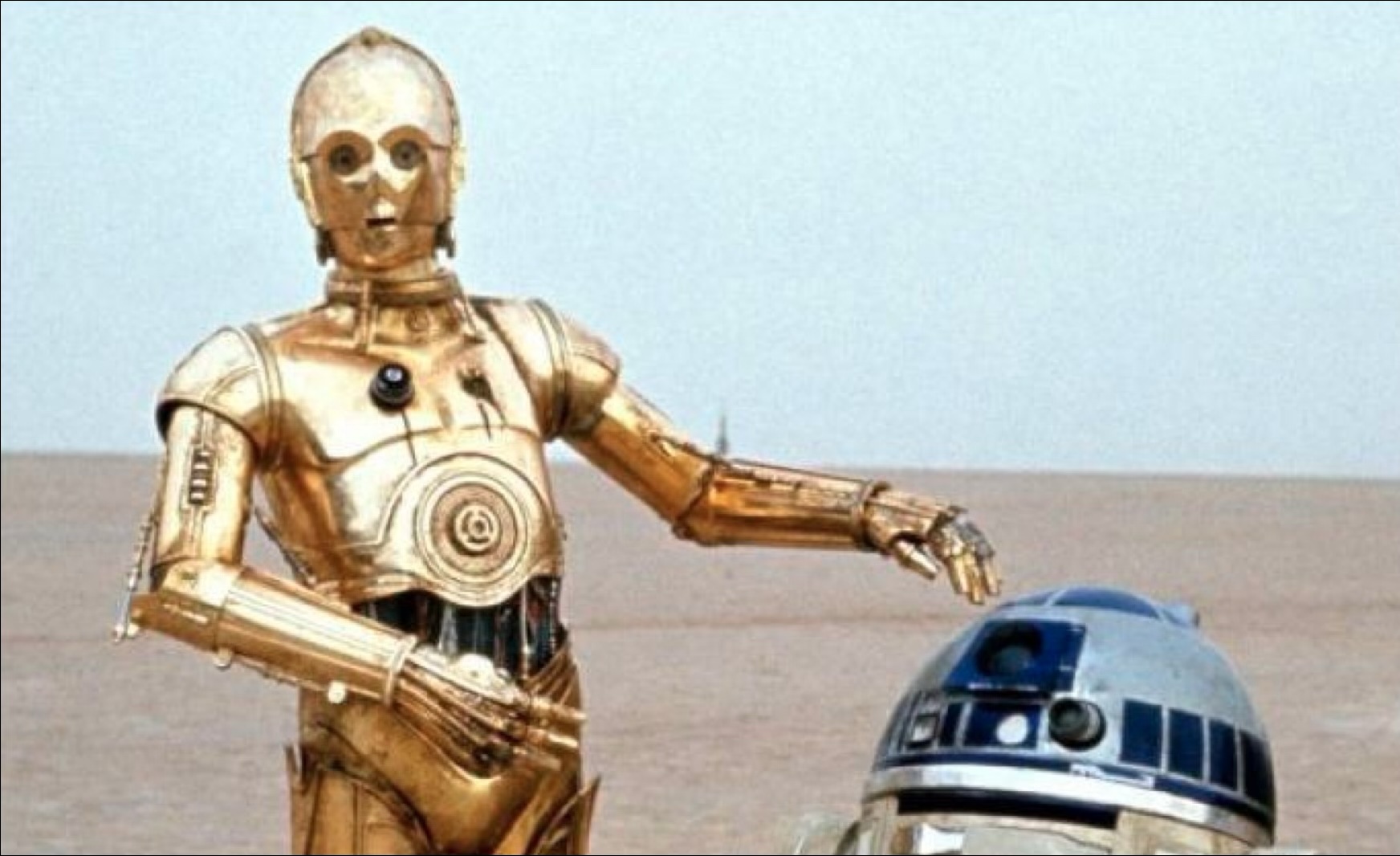
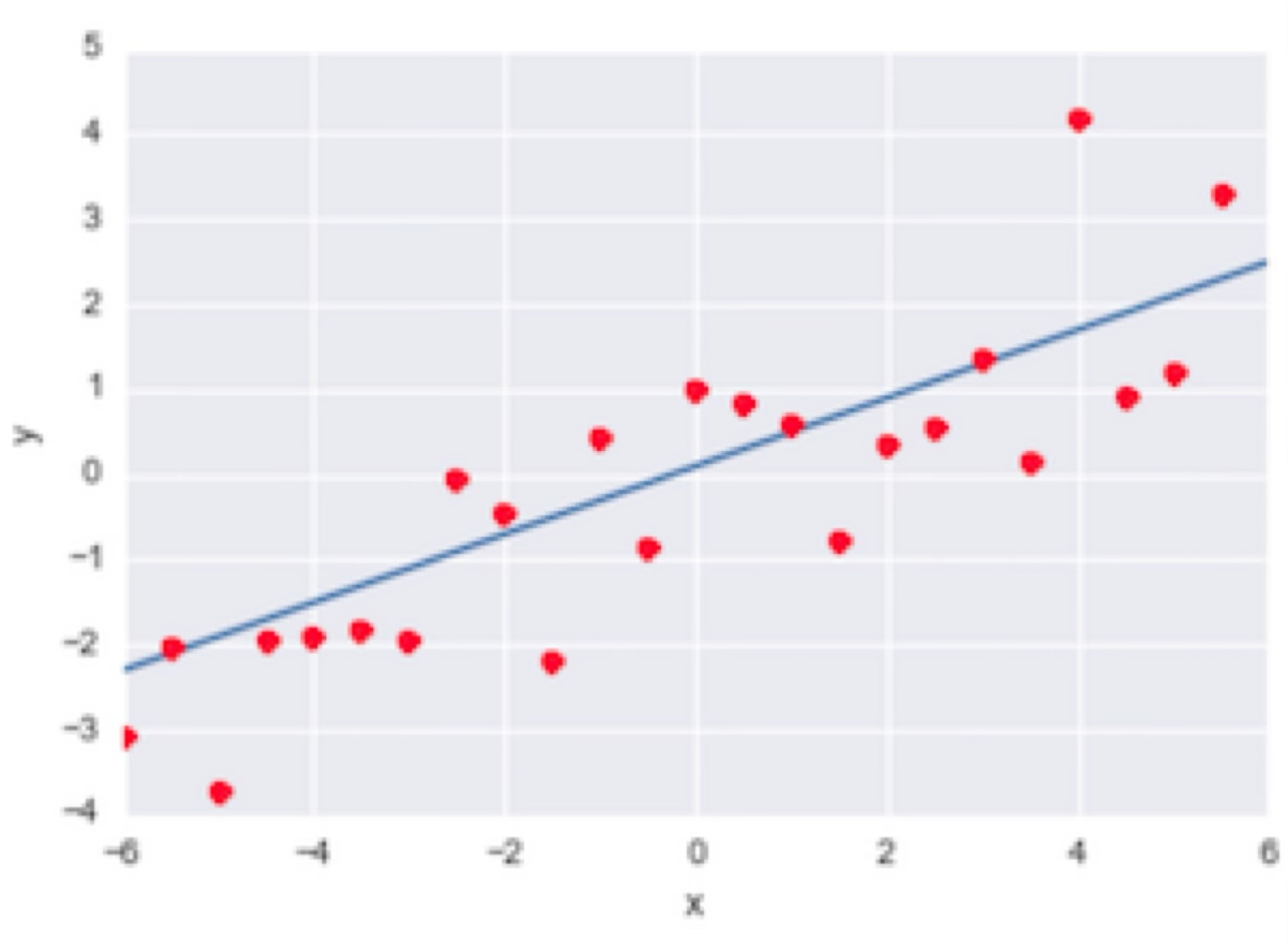
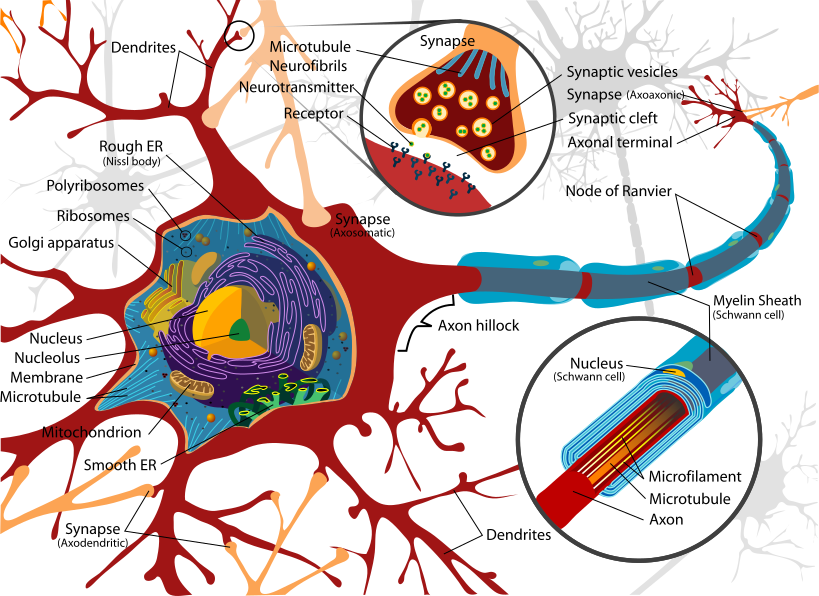
Science fiction AIReal-world "AI"
Storytelling is about people and their struggles
As long as we humans have had language, we’ve been telling stories. We tell stories to communicate information and to entertain, and in so doing, strengthen our social bonds.
Stories offer us a way to share information in a way that mere facts and opinions cannot. If I told you “Bob is a jerk” or “Bob is a nice guy,” you learn almost nothing. How is Bob a jerk or a nice guy? Maybe he’s neither, and I’m just judgmental.
If, on the other hand, I tell you what happened with Bob, then you get something like the raw data of Bob’s behavior, and you can add that to your own knowledge to form an opinion of him. You also form an opinion of me; my story might inadvertently make me look bad and Bob look good.
Storytelling styles and techniques have evolved over the millennia, but some of the basic elements that make a good story have stayed the same, whether it’s told over a campfire, over a few beers, or on the big screen at a movie theatre. Storytelling activates our evolved desires and needs, even if our needs in modern life have changed since the Pleistocene era.
An engaging story contains at least four things that signal its future value to you: lessons, surprises, emotional intensity, and relatable characters. An unsurprising story with unsurprising lessons doesn’t teach you much of value. Emotions signal what matters to us, so, if a story lacks emotional intensity, then the story feels less likely to give information about things that matter. If there aren’t relatable characters, then it feels less relevant.
Evolution taught our brains to care about stories with surprise, lessons, intense emotions, and relatable characters. And, because other people are such an important source of all four of these things, most of our stories emphasize relationship and conflict between people.
Every theory of story structure, from the three-act structure, to the story spine, to the hero’s journey, creates surprise, lessons, and emotion through a narrative in which a relatable character faces a challenge, struggles through it (often with others as allies or foes), and, finally, succeeds or fails.
Story, story, story, story, this is the prime, major focus of storytellers, the thing they are obsessed with and struggle to do well, and everything else is in service of story. A movie with great characters, actors, and special effects but bad story will fail.
When I worked at Pixar, and learned about their storytelling processes, it was always laser-focused on creating compelling narrative and emotions. (One now-public set of lectures that I absolutely loved is Michael Arndt on screenwriting; check them out!) They spend literally years refining each story before beginning production, or else abandoning stories that “aren’t working out.” They never ask “is it realistic?” but they ask “will the audience accept it?” You can have teleportation or talking cars as long as the story has a consistent internal logic.
The Functions of Movie AIs
Story drives every big decision in movies and television, and so I think we can describe movie AIs as serving one of three different story functions: character, plot device, or non-story AI. These categories are not all mutually exclusive.
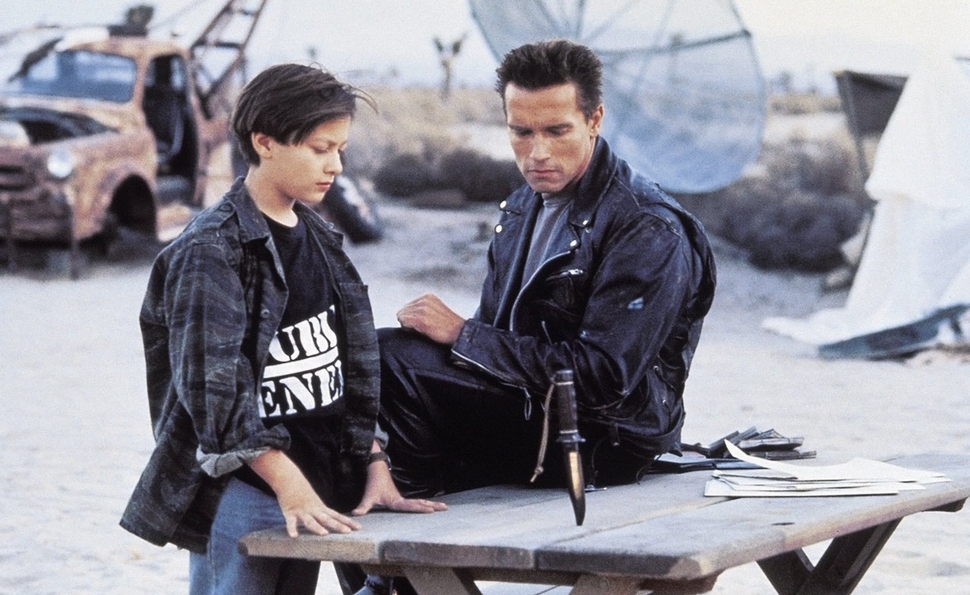
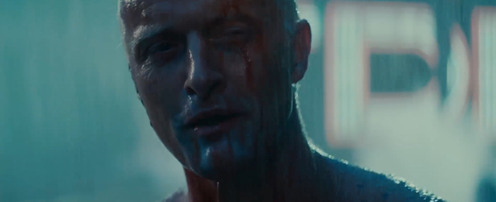
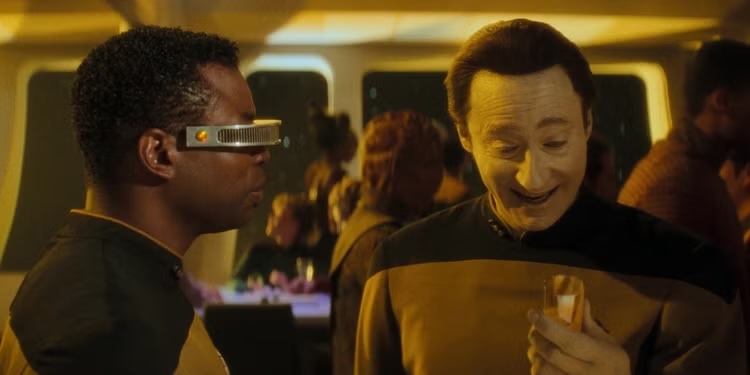
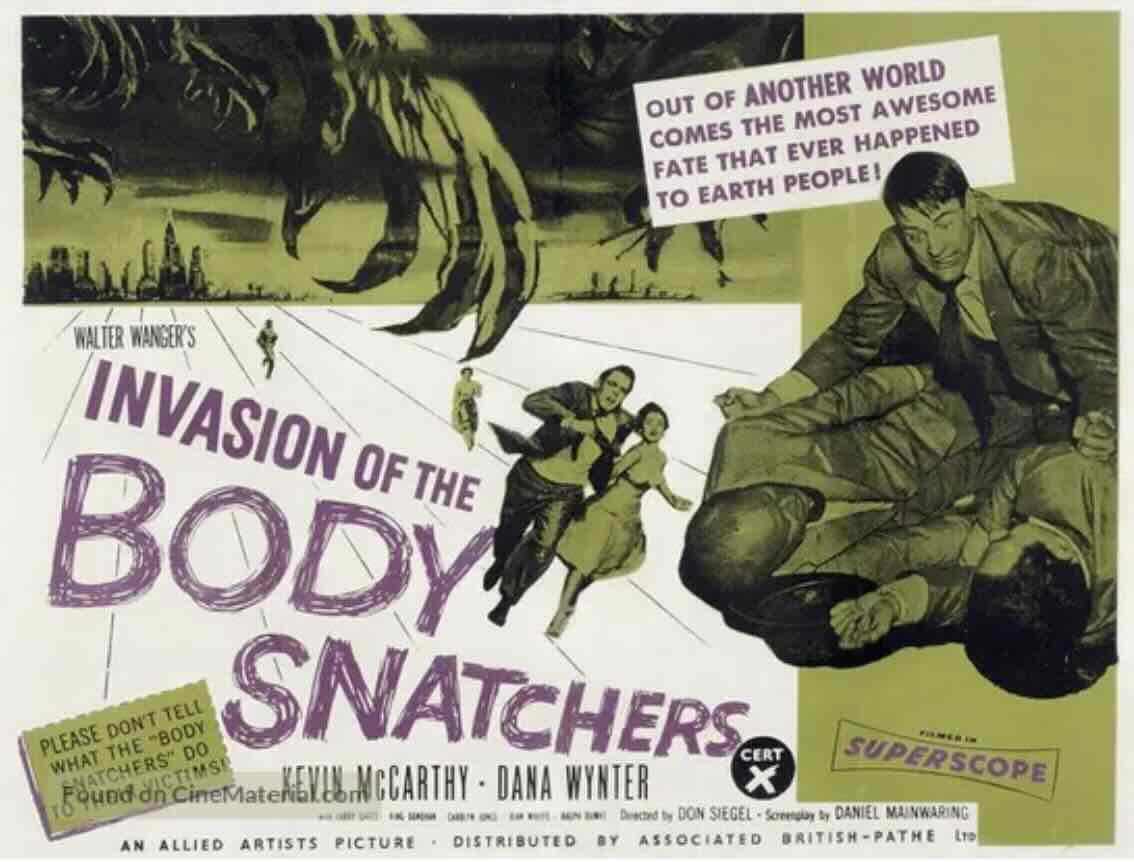
Science fiction AI characters are essentially modified people. Movie AIs are human with individual twists or quirks. The sympathetic ones may be emotionally naive, like Data in Star Trek, wanting to learn about being human. (Data is sometimes described as an autistic character, and as a favorite of autistic viewers.) In Terminator 2, the protagonist terminator is an emotionally-distant father figure to John Connor. WALL-E is lonely and childlike but discovers love. The Blade Runner AIs are tragic people. Kryten in Red Dwarf is a comic sidekick. Unsympathetic AI characters tend to be psychopathic murderers (i.e., humans lacking empathy), like most Terminators, HAL 9000, Ultron, M3GAN, and PAL in the Mitchells vs. The Machines. Popular video game characters use similar tropes, like psychopathic GLaDOS and Wheatley or the comic sidekick Claptrap.
None of this is driven by scientific reasoning about what an actual AI technology might be like, or by any real thinking about what it means to build an artificial agent.
John Connor bonding with his emotionally-distant father figure
Of course these AIs are people—almost all movie characters are basically people. Whether the characters are talking animals, talking toys, talking cars, talking computers, or talking aliens, they’re all modified people. In the movies, if a dog is a character, then that dog has all sorts of the future planning and knowledge that real dogs do not have. A movie dog is a person with dog-like qualities, not a dog with human-like qualities.
Roy Batty experiences his final qualia
Sometimes AI characters are (at least, partly) fantasies for male viewers.
Plot-device AIs move the story forward without being characters in their own right; they lack real emotions and agency. They are either tools, like the Star Trek computer and Iron Man’s Jarvis, or villains, like Skynet. The story’s characters do not have any meaningful personal relationship with plot-device AIs; they simply use the AI or try to defeat it.
Plot-device Villain AIs, like Skynet and the Matrix AIs, have no voice or character; they exist solely to set the plot in motion. They are often an Unknowable Other, or a Force of Nature, like a tidal wave or volcano in a disaster movie. They’ve become a stock villain trope, just as Cold War thrillers typically used the Soviets as stock villains, and, after the Wall fell, terrorists became the enemy in most thrillers (in addition to corrupt government bureaucrats). Nowadays, it’s all lazily-written evil AI. In “Mission Impossible: The Final Reckoning,” the AI is described as omnipotent and capable of predicting your every move, and then is fooled by the protagonists over and over again. The filmmakers even gave it a bland, generic name: “The Entity.”
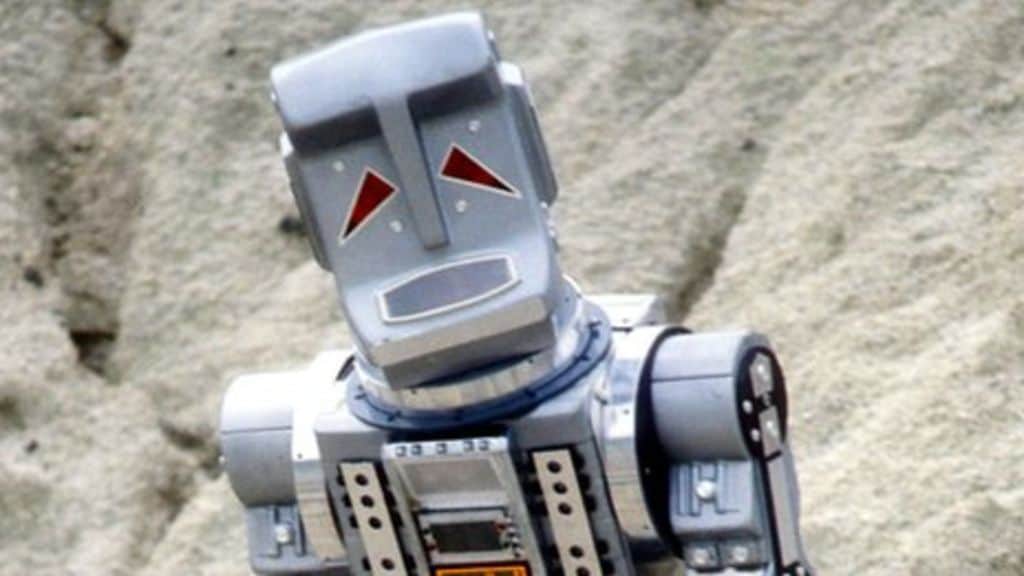
Non-story AIs are just set dressing that play no real role in the story. Mostly they’re unnamed droids running around in a futuristic background. I can only think of two named examples: Max Headroom and Marvin the Paranoid Android. Both added a lot of comedy and satire, but neither had any particular impact on the plots of their stories, and barely any interaction with the main characters of their stories.
Marvin the Paranoid Android
Interesting case: AI relationships without consciousness
In a few movies and TV shows, humans have personal relationships with AI, but the AIs do not necessarily seem to be human-like or conscious. These examples do seem relevant to real AI, and even prescient about the ways people use LLMs for personal relationships.
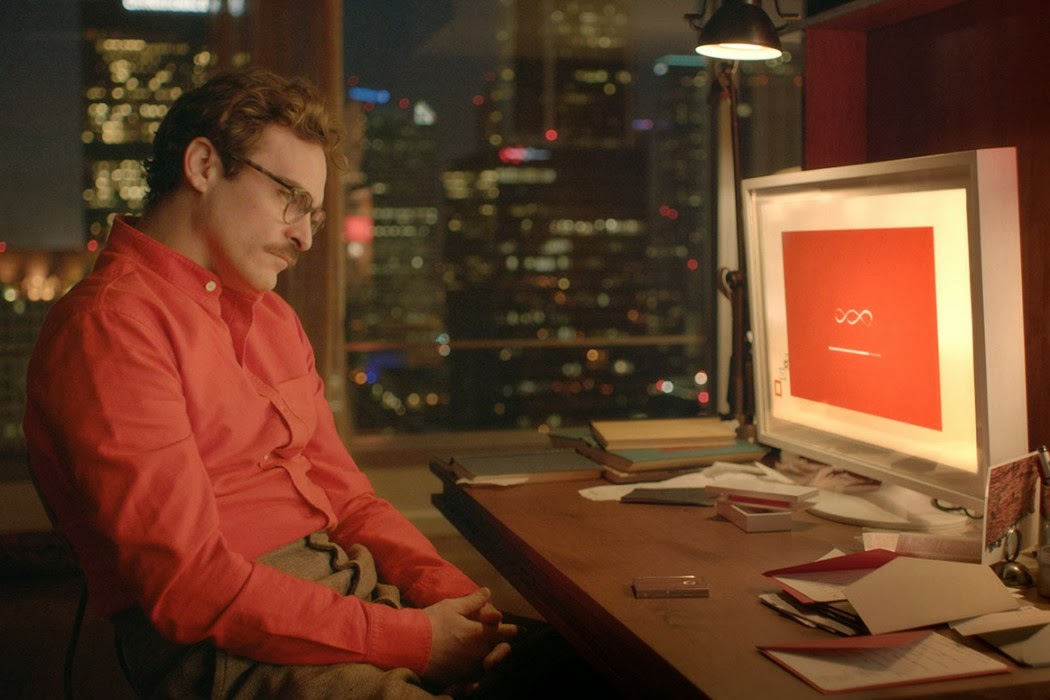
The movie “Her,” portrays a romance between a human and a voice-only agent named Samantha. You can enjoy this movie (as I did) without believing that Samantha is really conscious or alive; she could be an LLM-like chatbot with voice synthesis. The movie is really about the main character’s journey, and his relationships: his painful divorce, his ultimate reconnection with other humans in his life, and the role of technology in that journey. Samantha functions as a secondary character, an emotional prop.
Man has emotional relationship with computer
Likewise, Black Mirror’s “Be Right Back” now seems prescient about the use of technology to simulate a dead person’s behavior.
Could you do this for any TV or movie? I don’t think so: storytellers use acting, editing, and cinematography to communicate what we’re supposed to believe about our characters. But it’s fun to imagine.
Imagine watching any movie with a sympathetic robot character, but without yourself believing that the robot has consciousness or real feelings. See Data as merely a chatbot, providing a simulated relationship to the humans around him. Imagine all of C-3PO and R2-D2’s bickering as generative simulations of personality. Imagine WALL-E as an automaton, mindlessly following its programming, no more alive than the automatic house in “There Will Come Soft Rains”. It would really change the experiences and messages of these movies and shows.
Watching Star Trek would be a very different experience if you understood Data to be a mindless chatbot, like an LLM.
Science fiction is a great exercise but a poor guide to the real world
Beyond entertainment value, fiction lets us experience and learn about lives outside of our own, expanding our understanding, gaining the benefit of other people’s experiences, and building empathy for other people. Science fiction helps us practice imagining worlds with very different technology, and its effect on people.
I love lots of science fiction movies and books, but I do not expect them to provide a guide to our real world. Science fiction is great at imagining possible futures and extrapolating from current trends. Science fiction authors have a terrible track record for predicting truly transformational technologies or their impacts, like smartphones and social media.
Science fiction typically functions less as literal prediction than as a metaphor. Mary Shelley’s Frankenstein explored fears about creating or devaluing life that arose from discoveries of the role of electricity in the nervous system. It was not a scientific prediction of the future.
Nonetheless, storytelling conveys information, and people walk away from sci-fi TV and movies with some residual concept of “AI” that the term “artificial intelligence” exploits. When the same word, “AI,” gets used for both the software and the movie characters, story after story quietly shapes what people think artificial intelligence actually is.
The false, fictional tales guide and shape our public understanding of the real technologies that are nothing like these fictions.
]]>Aaron HertzmannThe Brain Is Not Just A Computer, and Cannot Be Simulated by One2026-07-13T00:00:00+00:002026-07-13T00:00:00+00:00https://aaronhertzmann.com/2026/07/13/brain-not-a-computerOver the past eight years, I’ve given many talks to computer science audiences, arguing that computers will not be considered artists. And very often at least one person says that I’m wrong, because:
The human brain is just a computer, or
A human brain can be simulated in a computer, by simulating the physics of the world,
and so computers can be artists.
This is about more than art—it’s about all of “AI”. If the brain is just a computer, then it follows that we can someday build computers with human-like intelligence and consciousness… and maybe we already have. If, on the other hand, the brain is fundamentally not a computer, then that makes “intelligent AI” or “conscious AI” far more speculative. Philosophers and neuroscientists have long argued over this question, but recent developments give it a moral urgency.
These opinions seem deeply held; one computer scientist accused me of being a creationist simply because I said there’s some important difference between human brains and computers.
In this blog post, I explain why the brain is not merely a computer, and cannot be simulated by computers. By “computer,” I mean digital computer, like the ones that we all use so much of the time. Digital computers are human-made systems that perform fixed logical operations on rigid clock cycles, with meaningful abstraction layers across scales. Human brains are biological systems integrating electrical, chemical, protein, and fluid interactions, with unimaginable complexity over literally billions of neurons and other types of cells, involving continuous-time continuum mechanics, across scales from the subatomic to the visible.
One argument we often hear is: brains are enormously complex and hard to understand, but so are artificial neural networks. So it makes sense that they could model the brain. But just because two things are complicated does not mean they are the same. Personal relationships are complicated, and quantum mechanics is complicated, but that doesn’t mean they are anything like each other or like the brain. These things are all complex in totally different ways.
Regardless, none of this shows that the brain is just a computer.
Real computers use digital logic, unlike brains
The word “computer” can mean a few different things in different contexts. This blog post is about real computers that we can build. It is not about theoretical computers, nor about hypothetical science fiction computers. If we allow for science fiction computers, then literally anything is possible. Most of us care about what is actually possible in the real world that we live in, this year or in five years, not in the year 3000.
Real computers—the things we actually build, the one that I’m writing this on, and the one that you’re probably reading this on—are based on digital calculations. All data is converted to digital information (0’s and 1’s), and processed using logical calculation, either with logical circuits embedded in silicon, or, indirectly through stored programs that determine processing logic. A CPU or GPU operates in a fixed clock cycle, where each logical operation on the circuit happens in sync with all the others; multiple CPUs used together may each have their own clock cycles.
A foundational ideas of computing is to separate what a computer computes from how it computes it; computers are engineered into cleanly-separable abstraction layers across scales. You can run the same software on different operating systems; you can run the same operating systems on different physical computers; you can implement the same digital logic systems with different kinds of electrical systems, whether silicon transistors or vacuum tubes; a person could even work through the calculations by hand with pencil and paper. You can write emulators that perfectly simulate old computer systems in new ones. Modern silicon designs are staggeringly complex, but their modular designs allow teams of engineers to create them.
A brain is formed of flesh and blood, proteins and chemicals, and is an inseparable part of a biological, living organism. It lacks binary logic bits, fixed clock cycles, or stored programs. The brain is obviously not a digital computer.
It could be that the brain is some other kind of non-digital computer, but, as we will see, that framing would be very misleading.
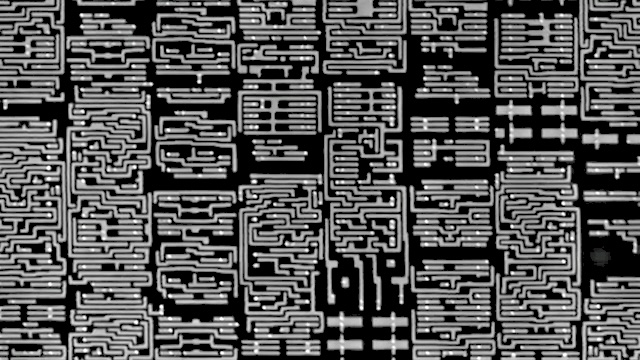
Zoom into a CPU, and you will see interpretable digital logic circuits, created by human engineers. (Source)
The mind-boggling complexity of brains
Before going further, let’s go slightly deeper into what we know about how brains work.
The brain has an enormous number of mechanisms, and all of them interact with each other in complex ways, from blood flow to electrical connections to chemical signaling to electromagnetic waves and more. And these complexities operate across scales that all interact.
Biological neurons are cells that receive and transmitting signals. Neurons exist in a “chemical soup” and their outputs depend on an enormous number of physical, electrical, and biochemical factors: the physical shape of the individual cell; the cell’s recent history; tens of thousands of ion channels (biochemical receptors on the cell surface, which can have hundreds of distinct electrical and chemical behaviors); chemical signalling (such as diffusion of nitric oxide synthesized in blood vessels, diffusing in the brain, and affecting signalling between neurons); physical forces between neurons; local temperature fluctuations (which can affect brain firing frequency); the collective electrical field produced by neurons, affecting their firing; numerous other kinds of cells, like glia which affect synaptic transmission for nearby neurons; blood flow that transmits signalling molecules from other parts of the body.
In contrast, a digital logic gate in a computer implements one operation, like AND or XOR. An “artificial neuron,” as commonly implemented, is a weighted sum of numbers, followed by a nonlinearity, such as setting negative numbers to zero. Modern “AI” is largely based on a single mechanism, for which a sixth-grader could do the calculation.
In short, a brain involves electrical signalling, chemical signalling, proteins, blood flow, electromagnetic fields, with thousands and thousands of different types of mechanisms, all continually operating together across multiple scales from the visible to subatomic particles, without digital logic or clock cycles. Brains do it all on a steady 20 watts of power, much less than a typical laptop.
Unlike digital computers, brains do not have abstraction layers. In the words of neuroscientist Anil Seth, there is no distinction between wetware and mindware: “it is hard and perhaps impossible to separate what they do from what they are.”
My description here is primarily based on an excellent paper by neuroscientist-philosopher Rosa Cao; see that paper for a much more in-depth discussion of these issues and their philosophical implications.
Ok, then, if the brain is not a computer, then what kind of thing is it? Isn’t the answer going to end up just being some other kind of computer?
It does seem reasonable to say that “the brain is an analog computer.” Its job is to take sensory input (information) and produce behavioral signals: information in and information out. But this downplays just how profoundly different a brain is from anything that we can fully understand. We do have historical analog computers for relatively simple calculations, like slide rules and differential analyzers, made obsolete by digital computers.
There’s not much value in saying that brains are analog computers, because we have no useful, relevant theory for analog computing. The brain is nothing like a slide rule. Moreover, it would be profoundly misleading, because it sounds like a version of “the brain is just a digital computer.”
We don’t have a useful, comprehensive metaphor or model for what a brain is. A brain is just a brain.
Simulation requires us to know the relevant variables of a system and the physics of the system, and it requires sufficient computational power to perform this simulation. Each of these pieces presents, on their own, an insurmountable barrier to accurate simulation.
The human brain has 86,000,000,000 neurons, each of which averages 7,000 synaptic connections to other neurons, along with tens of thousands of ion channels on each neuron. These neurons have countless other interactions and mechanisms, many surely yet to be discovered. It is unclear if we will ever fully know all of the mechanisms. And, our supercomputers struggle to simulate much, much simpler systems accurately.
One might think we could abstract out some elements of the system. We don’t need to know where every nitric oxide molecule is. Perhaps we could approximate the behaviors of individual neurons, or simulate multiple neurons on some abstracted level. But such approximations will likely lose important information; the joint behavior of two neurons is likely to be combinatorially more complex than a single neuron alone. Moreover, Cao argues that the function of neurons may be intimately tied to their physics by the principle of “generative entrenchment,” so that simplifying their behavior loses important mechanisms. Neurons lack the conceptual modularity that we’re used to in digital computers.
There are indeed attempts to simulate brains, such as a recent supercomputer simulation of the mouse brain. But this simulation abstracts out many of the specifics and details that I’ve mentioned, while also lacking an interface to the rest of the body, and, while this research sounds useful, it seems unlikely that it will be able to truly simulate human thought or behavior any more than an LLM can.
"Theoretically possible" is not "actually possible"
Suppose I asked you to multiply a billion times a billion, by writing a billion tickmarks out on a piece of paper, one billion times. In theory, you could do it. None of it is theoretically or conceptually difficult. However, if each tick took a second, this would take you 32 billion years. So you can’t actually do it this way. It’s theoretically possible but not actually possible. And the fact that it’s theoretically possible is irrelevant to any further discussion; you couldn’t try to understand how the tax office works if you believed that all the accountants used tickmark arithmetic.
Likewise, it might be theoretically possible to simulate a brain, if we had a complete understanding of the underlying physics, chemistry, and neuroscience. But it might also require a supercomputer the size of a solar system. If so, it’s not actually possible to simulate it.
The difficulty of simulation
Anyone who has worked on physical simulation knows that it is much, much harder than it sounds. Just knowing the physics of a system and the state of a system is not enough. Tiny, tiny errors always magnify, and errors are a necessary part of simulation on digital computers, which cannot represent real numbers with infinite precision. People performing physical simulation typically navigate tradeoffs of speed and accuracy: you can make a fluid simulation for a movie that looks great, but it won’t obey real physical properties, or you can make a physically-accurate simulation of ocean waves that takes weeks to run and only captures a few cubic meters of water.
Even simple physical simulations can "explode." (source)
Fully simulating a truly complex system, like weather patterns, remains impossible. We can simulate the weather in aggregate, and we can make average predictions about the weather—just like we can with human behavior—but truly accurate simulation is beyond human reach even with massive supercomputers. As we all know from experience, no weather prediction is perfect.
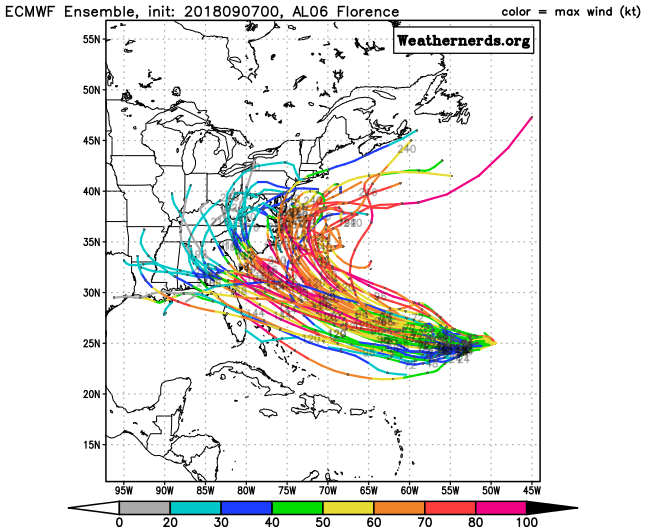
All weather predictions are uncertain, aggregate predictions. (Source)
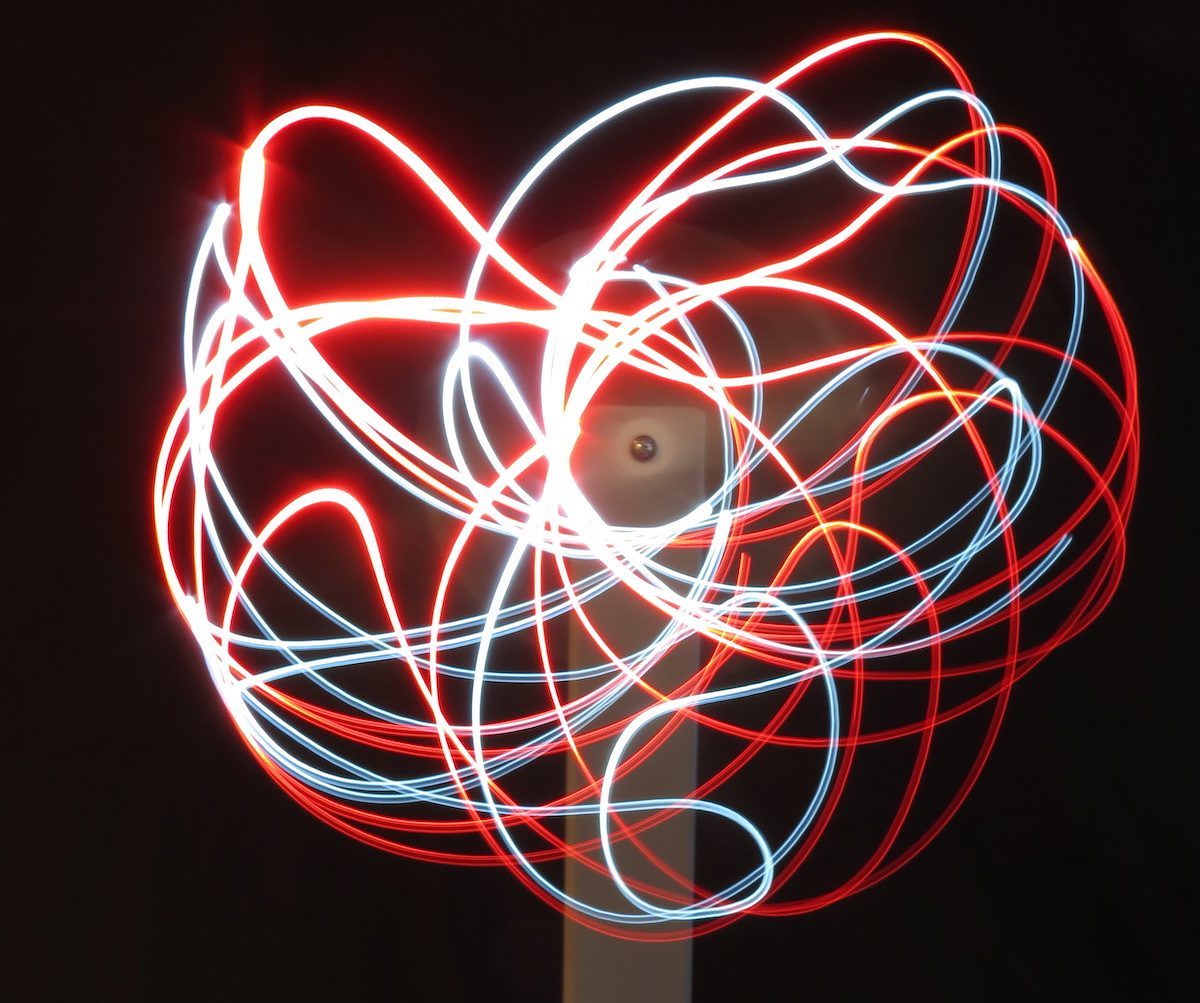
The situation is even worse for chaotic systems. Even very simple physical systems, like a simple double pendulum, can exhibit wildly varying behavior that quickly makes it unpredictable. Tiny numerical errors magnify so that accurate simulation would require enormous computing resources. And this is just for systems of two or three variables. A major element (and the title) of The Three-Body Problem derives from the fundamental unpredictability of chaotic systems.
The brain is an enormous complex dynamical system of uncountably many variables (i.e., continuous fields, not just discrete variables), involving electrical, fluid, and chemical mechanics, with complex feedback affecting neural function, likely with many chaotic elements.
Even if we somehow had a perfect simulator, the problem of determining initial conditions seems insurmountable. Producing valid behavior requires knowing the state of the system at some point in time. We can’t just boot up a brain from a raw install the way we can with a computer. Brains develop from fetuses through gestation in a complex biological process; the problem of initial conditions prevents simulating even a newborn baby’s brain.
Outside of science fiction, accurate, precisely-detailed simulation of the brain is simply impossible.
The chaotic motion of a double pendulum is very difficult to predict. Here it is shown with long-exposure photography. (source)
The differences matter
Neuroscientists and philosophers have long debated the relationship between brains and computers. Academically, it’s an interesting and important question.
However, the growth of “AI” companies create a new moral urgency. Treating brains as “just computers” risks either dehumanizing people, giving false moral weight to computers, or both. Either could be very harmful for society.
Here’s an example. One recent news story quotes billionaire owners describing people as “meat computers.” To my ear, this description devalues people, since neither meat nor computers have any moral rights or value. It suggests that they don’t think we have human rights, any more than a T-bone steak does.
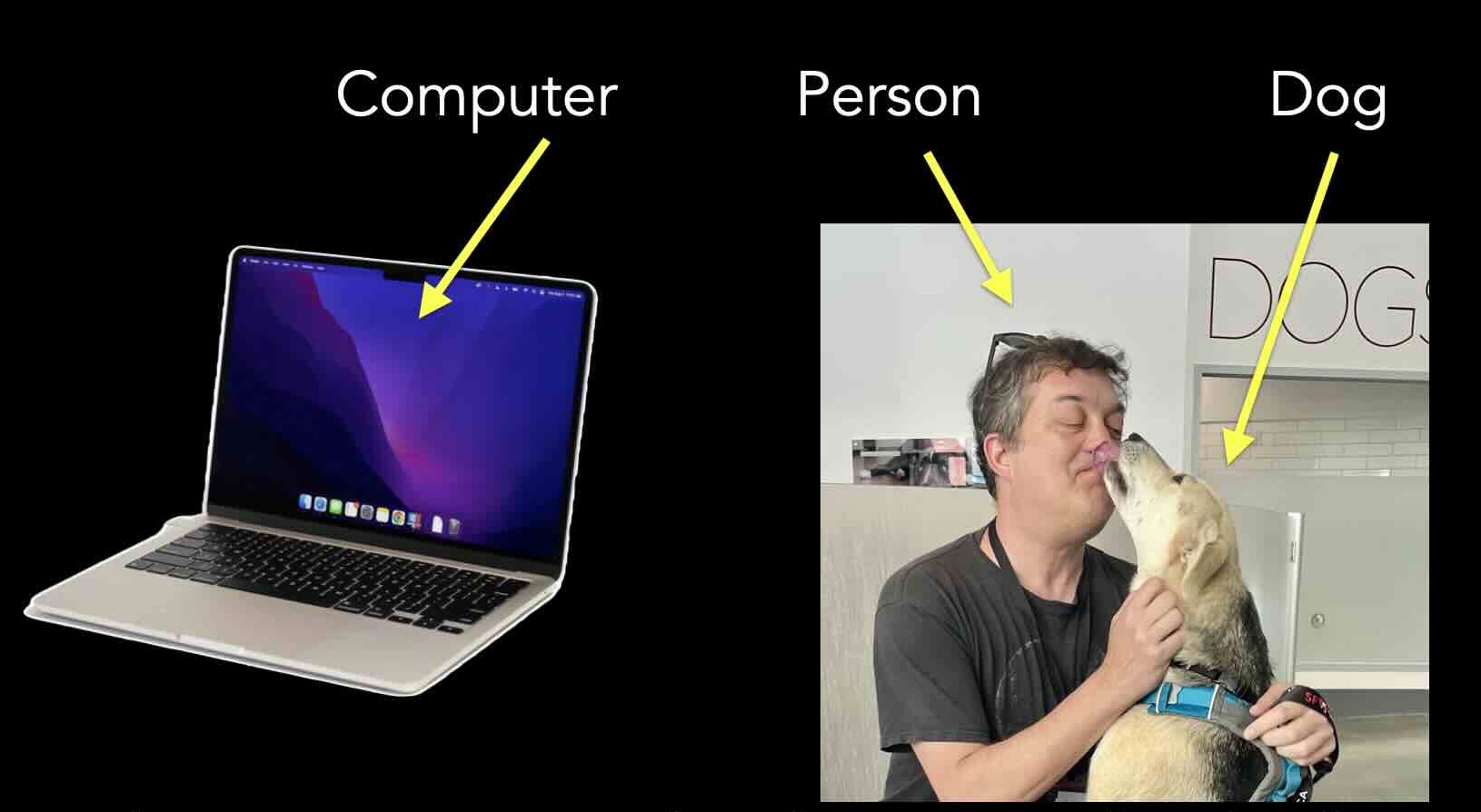
When I give talks, some people seem so insistent that people are just computers, and so I’ve searched for a way to simplify the point, which I do with this slide. Here’s a computer, me, and my dog:
When my computer grows old and unreliable, or simply cannot run the latest software, I will wipe its memory and recycle or discard it. But I cannot do this with other people or with dogs. Even though my dog cannot generate code or write sonnets in the style of Shakespeare, but she carries some intrinsic moral weight and value. Even if I somehow grow tired of her, or she grows old and infirm, I cannot just dispose of her the way I would a computer.
]]>AaronHertzmannScribbling, Abstract Art, and Visual Recognition2026-06-01T00:00:00+00:002026-06-01T00:00:00+00:00https://aaronhertzmann.com/2026/06/01/scribblingSometimes when I sketch quickly, I feel like I’m scribbling some random squiggles, and, yet, recognizable shapes of my subjects emerge:
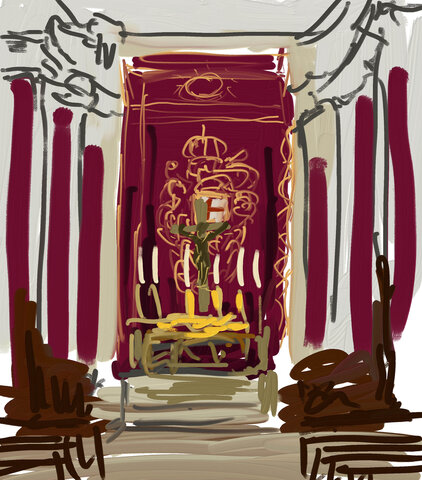
This experience feels a bit like magic when it works out, like pure fluid intution. And, to me, the drawings are visually interesting because many of the strokes do not correspond to visually-meaningful features, the way more conventional line drawings do.
This kind of scribbling also shows up in more-recognizable drawings. A lot of drawing a scene is about filling in plausible, sensible details rather than precisely drawing what’s actually there.
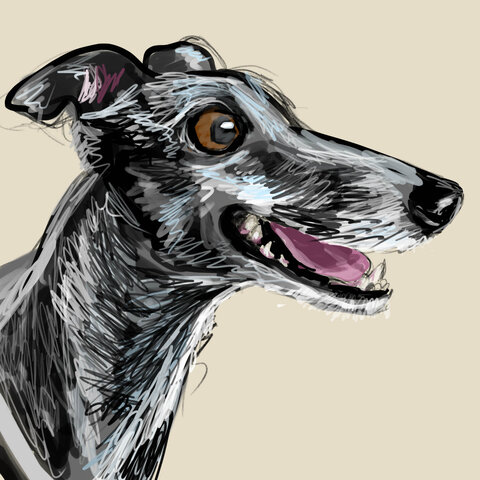
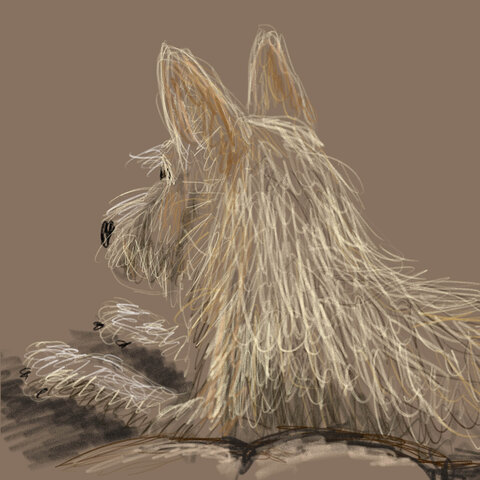
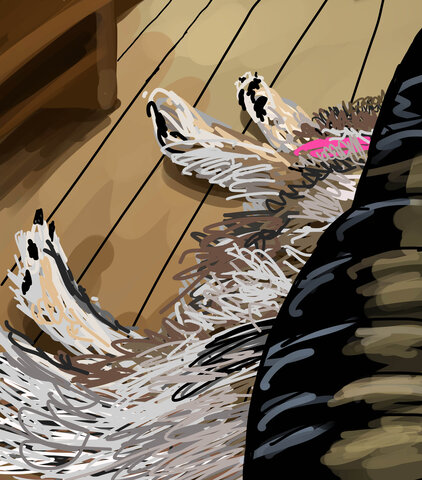
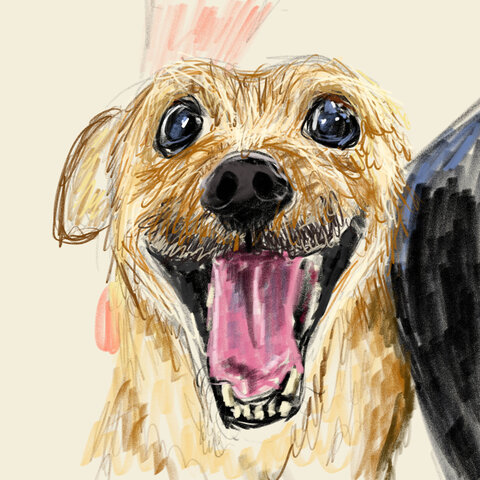
Here are a few drawings of dogs; key outlines and features are visible, but a lot of the detail and texture is just scribbling:
Sometimes I like to think of my sketching as “continually scribbling until it doesn’t look wrong.”
Statistical recognizability
To me, these kinds of drawings are suggestive of a sort of “statistical visual recognition,” by which I mean “recognition from statistics of a single image.” These drawings do not necessarily have natural visual features like contours, nor do they seem to fit with the usual demonstrations of Gestalt principles or the visual illusions (e.g., Kanizsa triangle) that illustrate perceptual inference. It’s not just scale space; e.g., downsampling the picture doesn’t make the object more recognizable, as like in Impressionism, hybrid images, or Arcimboldo paintings.
Instead, they seem more statistical, and, several abilities of human vision have been described in terms of the statistics of an image, including texture recognition, peripheral vision, and rapid scene recognition (“gist”). With some image classification deep networks have shown similar textural recognition properties, such as the adversarial examples in the “intriguing properties” paper and a paper that showed that these networks relied heavily on texture recognition, ignoring shape and other 3D information.
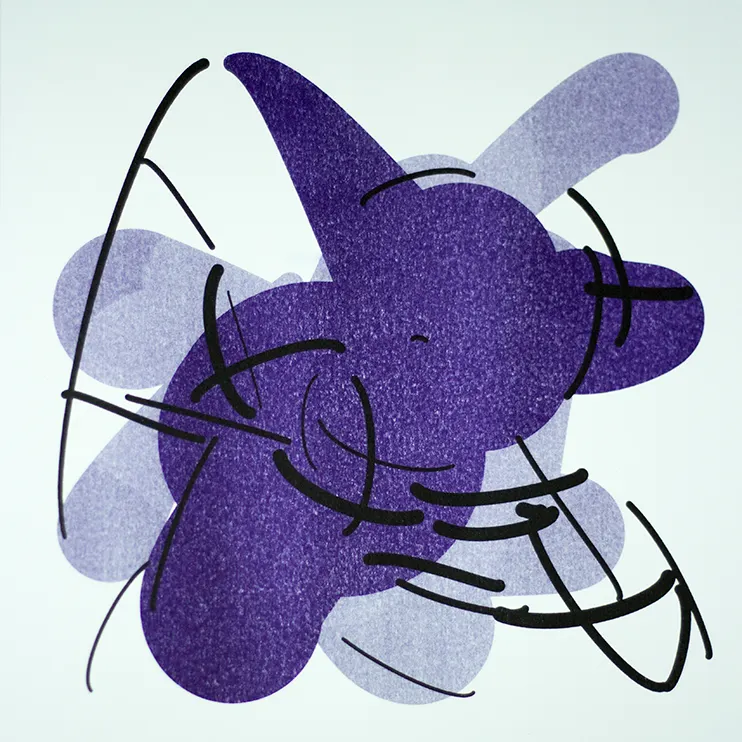
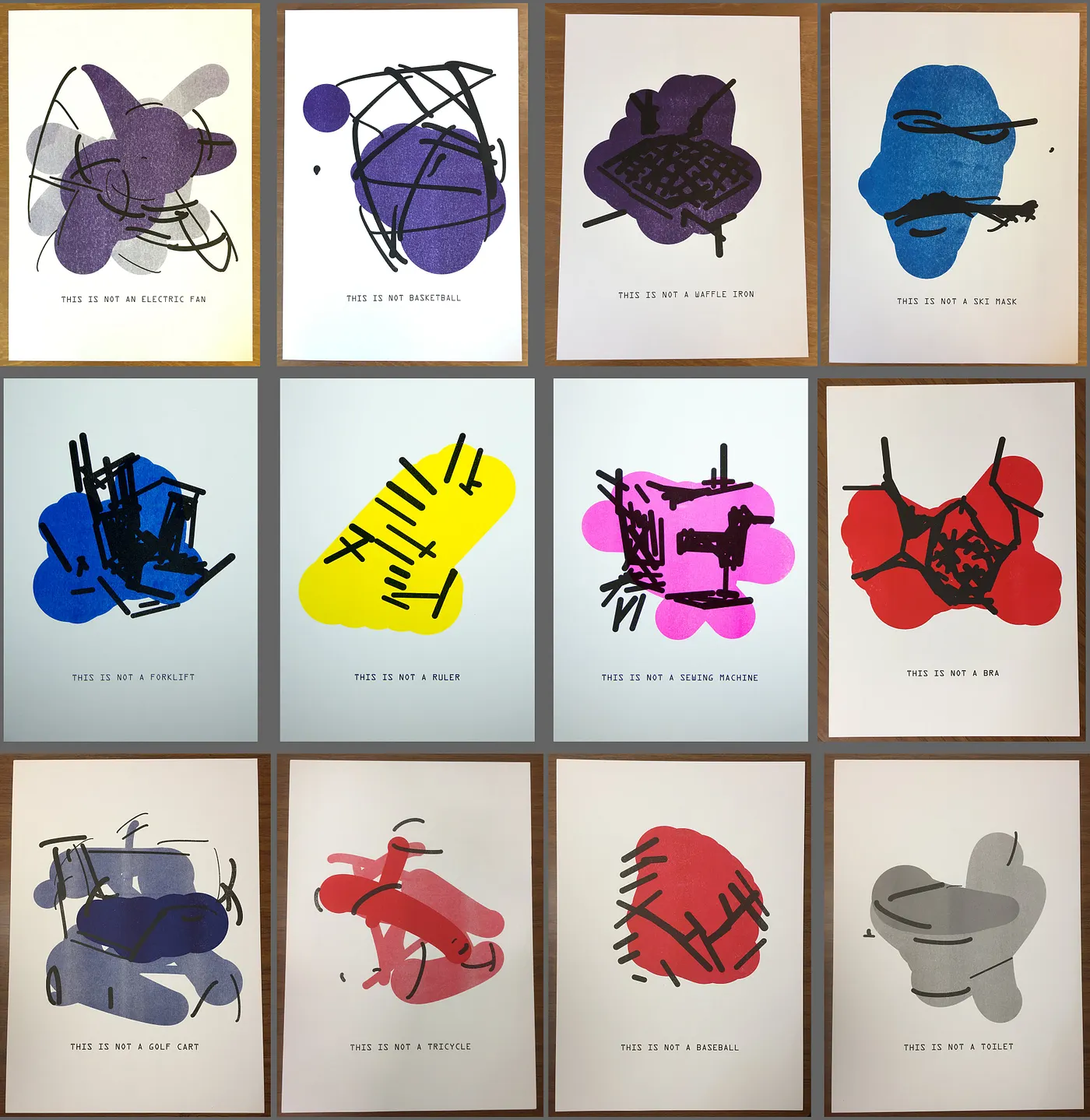
As a model for what’s going on here, the work of artist Tom White offers something very suggestive. For example, here’s a picture of an electric fan that Tom created in 2018:
Abstract art seems foreign and obscure to a lot of people. How do you appreciate it?
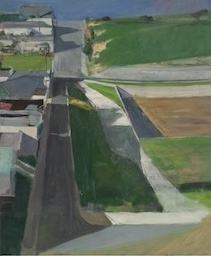
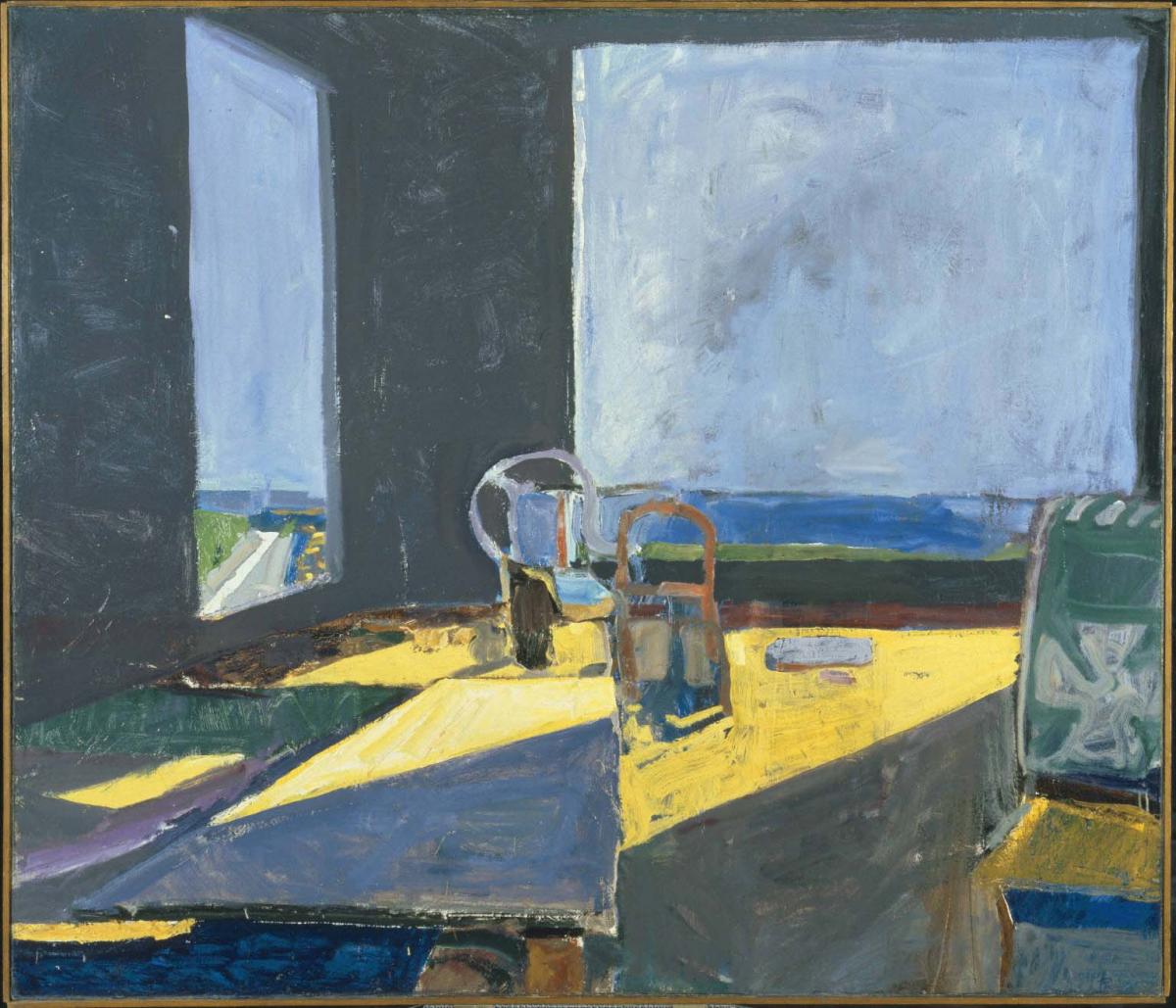
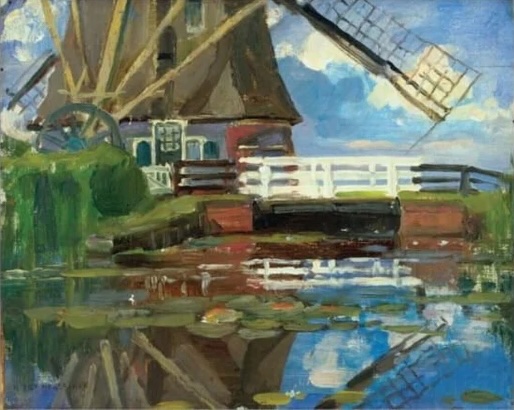
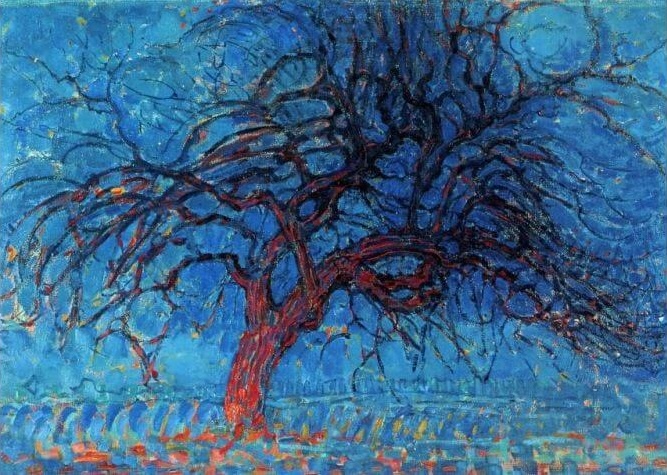
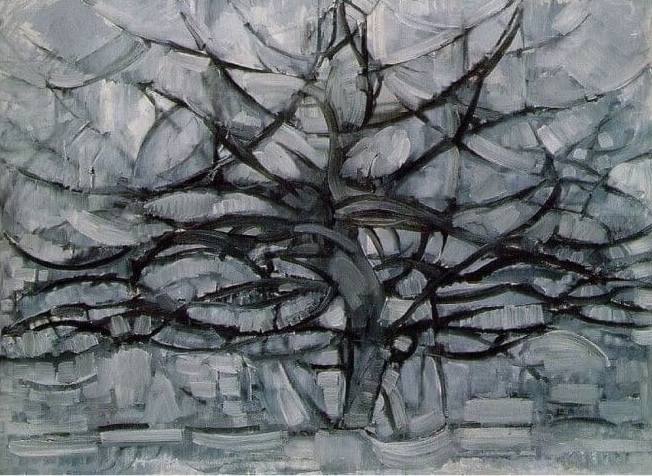
For me, one gateway to appreciating abstract art has been on a path from realism—what I would now describe in statistical terms. One of my favorite artists is Richard Diebenkorn, and you can see something like a progression or continuum from realism to abstraction in his work:
The last one is from Diebenkorn’s Ocean Park series, painted when he lived near the beach in Southern California. In the Ocean Park paintings, you can see the general statistics of beach landscapes. There are small shapes near the horizon and large shapes near the bottom, just as there would be in a perspective drawing or photograph with the camera near the horizon.
I see my own scribblings as a move toward abstraction. In the few situations when I have experimented with abstract drawing, I’m using the skills of realistic drawing (and scribbling), but removing recognizability.
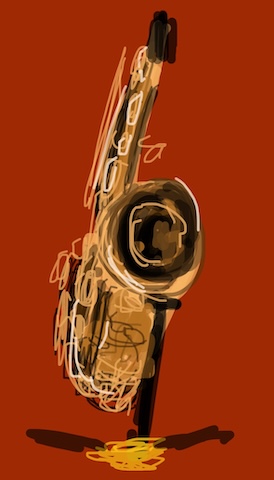
One way this manifests is when sketching on my phone, with my finger, which is naturally quite clumsy:
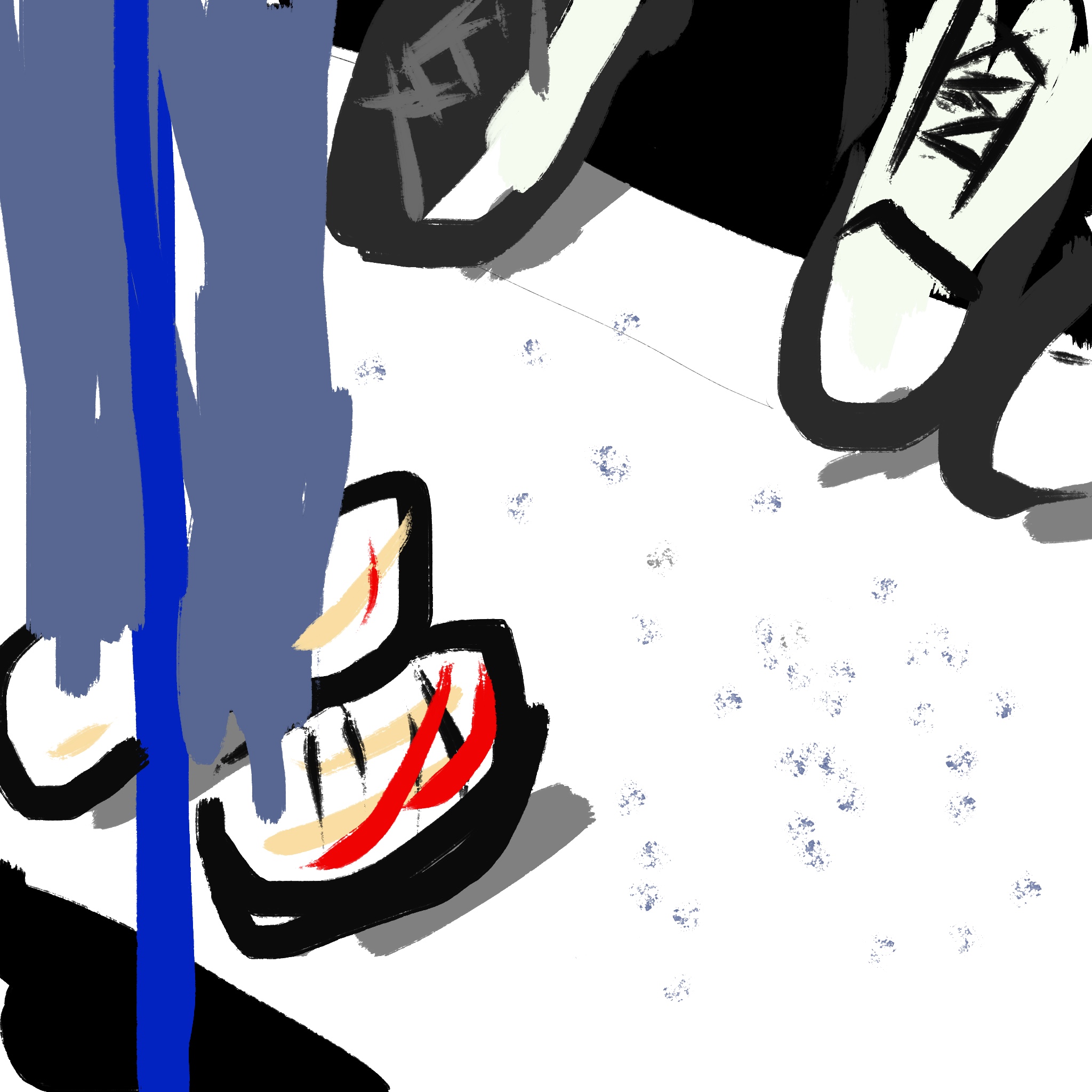
(The left picture was a drawing I made on my phone while traveling on the London Tube and looking at peoples’ shoes.)
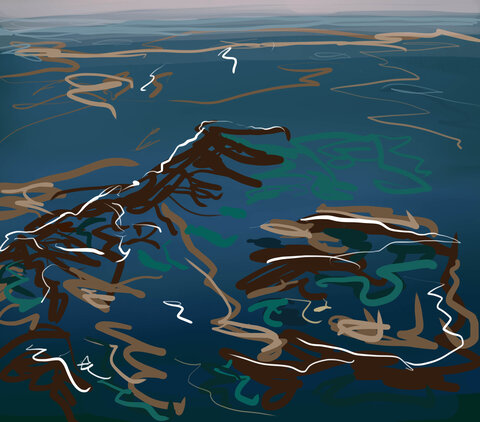
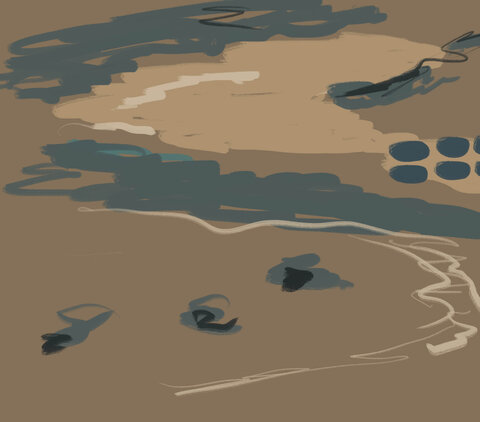
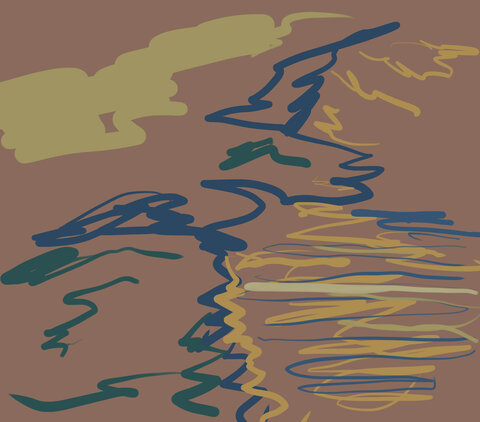
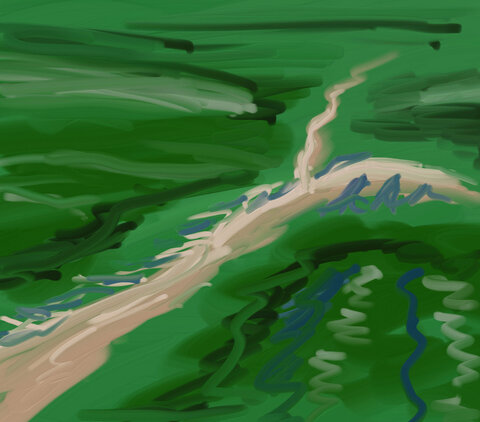
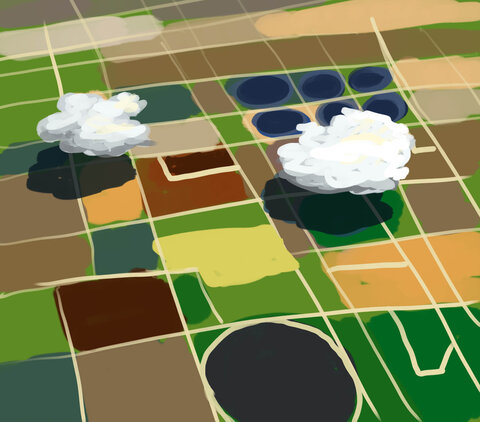
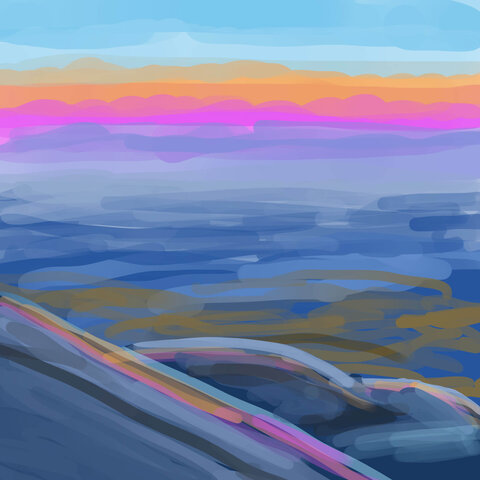
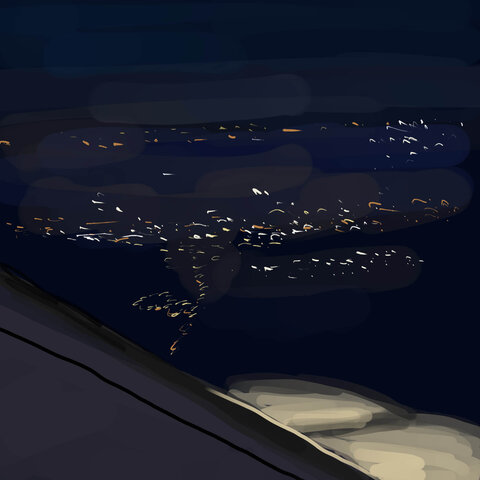
Another way is when I try to draw scenes out the window of an airplane (as mentioned in that previous post): the landscape is continually changing, so it’s impossible to capture a “snapshot:” any drawing is just pulling visual elements from what I see and mostly just creating some abstraction. Here are drawings from two plane flights:
For most of these pictures, there was never any single view that looked like the picture, most of these are sort of “temporal composites” of different things seen at different times.
Directions
Many of these ideas have been explored in the vision science literature in some way, but I think there’s more to do here. Specifically, the idea of image recognition as being based on statistical properties, together with the role of statistical descriptions of both realistic (but scribbly) and the hypothesis that abstract art “works” in relation to familiar, real-world scene statistics.
]]>AaronHertzmannPeople and Animals are Conscious2026-05-20T00:00:00+00:002026-05-20T00:00:00+00:00https://aaronhertzmann.com/2026/05/20/consciousness“AI” enthusiasts arguing for “AI” consciousness say: prove to me that you are conscious; I’ve heard this many times from computer scientists. Of course, there’s no scientific test for consciousness. So this is presented as a “gotcha.” The enthusiast often then suggests that this demonstrates a double standard favoring humans over AI, and that “AI” consciousness is just as plausible as human consciousness.
Here I propose an explanation for why you can know that other people are conscious, even if we cannot formally “prove” it.
The argument is simple: if you are conscious, and you know that other people have similar behaviors and similar biological brains to you, then they must have similar consciousness to you. The alternatives are too implausible to take seriously.
Likewise: the more similar that animals are to us, biologically and behaviorally, the more-similar their consciousness ought to be as well.
I am not proposing a solution to “the hard problem” of consciousness, meaning I do not offer an objective test of whether any “AI” or alien is conscious, nor do I offer an explicit definition of consciousness. My arguments here do not disprove the possibility of “AI” consciousness. However, they highlight the need to consider mechanisms (biology and/or algorithms) and not just behaviors when attempting to judge consciousness.
You, the person reading this, are conscious. You have some feelings, experiences, and awarenesses of each moment of your waking life. How do you know you’re not the only one?
Your behaviors relate to your inner life, for example, acting differently based on how you feel, and telling other people about it. And, for your whole life, you’ve observed other people talking about their inner lives, and behaving in ways that seem appropriate. You act one way when mad, and another when relaxed. You can recognize the relationship between others’ behaviors and their stated inner lives, based partly on your own inner experience.
But perhaps it is an illusion, or a lie. Perhaps everyone else around you is basically a machine, performing the behaviors as though they are conscious people like you, but they are not. Perhaps they are all “philosophical zombies.”
Two sources of information
We have two sources of information about other people: their behaviors, and what we know of their biology.
You and I are both human, part of the same species and the same evolution. We share, along with the rest of humanity, the same kinds of brains, hearts, nervous systems, and so on. We can eat the same kinds of food, we need the same kind of exercise and sleep and so on. You’ve probably never seen me sleep, but still know that I do sleep, without expecting me to prove it to you. Of course we mostly focus on the differences between us (say, food allergies, different tastes or preferences, neurodivergence), but it’s not like some of us can hibernate for six months at a time and others can metabolize gravel.
Our brains mostly have the same parts and the same functional elements at different scales. So it makes sense to believe that our mental states are similar too—we share the same broad palette of emotions and mental representations, even though they are expressed differently in different people.
Hence, these facts together give you every reason to believe that other people are conscious:
You are conscious
Other people are biologically very similar to you
Other people talk and behave in ways consistent with your experience of how your behaviors relate to consciousness
Indeed, we naturally take others’ behavior as cues to their mental state, and might question the mental wellbeing of someone who’s behavior seems inconsistent with a sensible mental state.
This, here, is sufficient evidence to live your life without seriously doubting other peoples’ consciousness. Doubting other peoples’ consciousness is purely an intellectual excerise, not something worth taking seriously in how we understand the real world.
The alternatives: paranoid conspiracy theory or irrelevance of consciousness
After all, what is the alternative?
It could be that you alone are conscious, and everyone else is merely performing behaviors of consciousness, despite sharing the same biology. This seems to me a paranoid conspiracy theory, like imagining that we live in a simulation or some other constructed reality. No one can disprove such fantasies, but there’s no genuine reason to believe them either, and, even if true, they’re irrelevant to any decision we’d make in our lives.
It could also be that most people are conscious, but some rare individuals lack consciousness while still functioning in society. There are lots of examples of rare individuals that lack other perceptual or mental attributes, such as colorblindness, aphantasia (lack of mental imagery), stereoblindness (lack of stereo vision), to sociopathy (lacking compassion for other people). Some of these are hard to detect, but they are detectable (even though sociopaths might perform compassion). If there were philosophical zombies amongst us, you might think that we would have already discovered it somehow.
If there were no genuine differences in behavior between people with consciousness, and philosophical zombies (who claim to experience consciousness but do not), then that seems to imply that consciousness is irrelevant for normal life. That is, consciousness has no noticeable impact on a person’s behavior or ability to function; it just randomly appears in some individuals but not others.
Each of these alternatives seem so implausible as to be unworthy of serious consideration.
The only sensible possibility is that everyone who is awake is conscious.
Philosophical zombies, among us?
The varieties of consciousness: altered states and animals
Regardless, the same reasoning as above can tell us that mammals are conscious. Consider chimpanzees and dogs, each of which are social animals and each is related to us biologically, including in terms of brain structure. They each exhibit behaviors that seem to indicate consciousness, such as social expressions of inner states (happiness or anger, etc.), and other sorts of behaviors (attention, distraction, etc.). We share similar internal organs, similar brains as monkeys and dogs, and some of the same behaviors. We share evolutionary lineages with them as well; they are evolutionary cousins. Hence, they ought to share some sort of consciousness as well, by the same reasoning as above.
And, the alternatives to animal consciousness seem highly implausible. If no animals are conscious, then consciousness emerged solely in humans. But nearly all of our faculties evolved in earlier creatures; monkeys have many of the same faculties of intelligence as us, as do their ancestors, and their ancestors. Consciousness seems most closely tied to mood, emotion, alertness, awareness, social behaviors—all attributes shared by many animals—and not to the few things that seem to make us biologically unique as humans, such as the ability for complex spoken languages.
It seems likely that more-sophisticated intelligence goes along with more-sophisticated consciousness. Dogs have much less-sophisticated intelligence than humans, and so their consciousness would be much less-sophisticated as well, but still present.
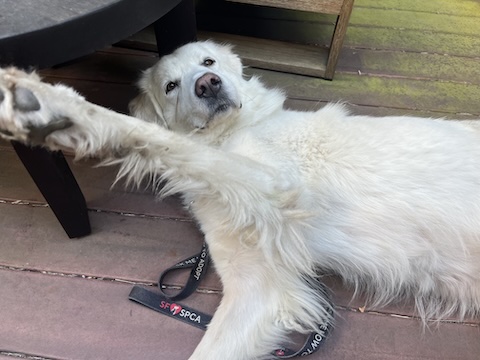
Nicole paws at me when I stop petting at me, asking me for more
Machine consciousness and alien consciousness
We cannot apply the above arguments for machine intelligence, because machines do not share biology with us. Current “AI” algorithms do not at all operate like human brains. There are ways in which they do operate similarly, e.g., convolutional network models of the visual cortex, dopamine as modeled well by reinforcement learning, but these are small pieces of the overall functioning.
This does not disprove “AI” consciousness, but it shows that establishing “AI” consciousness is far, far, more difficult than human consciousness. Which seems obvious, but apparently is not to some people.
How would we demonstrate or prove machine consciousness? I don’t think anyone has a good answer. However, I do not believe that we can judge consciousness simply by looking at behaviors, like performing Turing Tests. We’ve already seen over and over that people can be fooled by simple rule-following chatbots like ELIZA. We can build convincing philosophical zombies.
How do we know that chatbots like ELIZA are not conscious? We read the paper, or look at the code to see how it works. We can know enough about how LLMs work that to know that they, too, are simple text processing engines that, like ELIZA, literally do nothing more than take text strings as input and generate text strings as output.
If aliens arrived on Earth, and they seemed biologically similar to us, and they had evolved from primordial ooze on their own planet, then it’s certainly reasonable to understand them as conscious. But this is total science fiction; xenobiology is (to say the least) a pre-paradigmatic field: it doesn’t make sense to speculate about alien biology until we’ve actually met them.
It might be that computer algorithms could be described as “conscious” if they have any mental state representation at all, like state variables representing “mood.” But such representations are so different from human consciousness that calling them “consciousness” in public discussion seems misleading and extremely irresponsible (a topic I intend to exapnd on in a future blog post).
All of these arguments indicate that judging consciousness, we have to consider the underlying mechanisms, that is, the algorithms and/or the biology, and not just inputs and outputs. Similarity to our own biology would be a positive clue; algorithms that generate print statements as a functions of inputs would be a negative clue.
Summary
I have argued that you can know that other people and animals are conscious, because you are conscious, and because you share important behaviors, biology, and evolution with other people and with animals. This is not a solution to the “hard problem,” and it is not rock-solid scientific proof. But you can be confident in it enough to assume that it’s true—the alternative involves paranoid conspiracy theories or philosophical zombies well-hidden among us. On the other hand, there’s no good reason to believe that algorithms, which have totally different development, substrate, and behaviors from us share this one hidden attribute.
Note: since writing this, I came across this reading list of papers on animal consciousness, particularly for animals like fish and crabs that might not feel pain at all. (My post is most primarily about dogs and other domesticated animals.) And, here’s a complementary paper on AI welfare.
]]>AaronHertzmannDogs Do Not Know Things2026-05-15T00:00:00+00:002026-05-15T00:00:00+00:00https://aaronhertzmann.com/2026/05/15/dog-knowledge
“On a bench one afternoon in a grassy park in Minneapolis, I realized what I liked best about the dogs of Minneapolis is that they have no idea that they’re in Minneapolis.” —Billy Collins, In Praise of Ignorance
When you spend time with a dog, you have some ideas about what’s going on in its head. You get a sense of its moods, whether it is happy or tired or afraid. Taking care of a dog, or training it requires you consider its moods and its needs. Naturally, we understand their expressions to our own, and we often talk about our dogs like they’re our children, to be nutured and guided and trained. But, sometimes, these human analogies mislead us.
Specifically, we often describe dog behaviors in terms of knowledge. “She knows that if she sits, she gets a treat.” “He knows he’s not supposed to be on the couch.” “To deal with separation anxiety, she has to know you’ll come back.”
In this blog post, I’ll explain why I believe that dogs do not know things, not in the way that we do. If dogs had knowledge the way we do, they ought to be able to perform some kind of conceptual reasoning or planning. But they do not exhibit any behaviors that require conceptual knowledge. Importantly, dogs do not know about the future, and so they cannot plan for the future either. I’ll talk about what kinds of intelligence dogs do have, and how these can be mistaken for knowledge.
Much of the time, talking about dogs as if they have knowledge or planning ability is simply a convenient shorthand. But misunderstanding dog psychology can lead to bad experiences and poor relationships with them. Conversely, better understanding of dogs can make us more empathetic toward them, strengthening our bonds.
I am not an expert; this is just my interpretation based on my experiences and the books I’ve read on dog training. (For a cognitive psychology take, see this thread responding to this post.)
This post is decorated with photos of dogs that I’ve worked with at the San Francisco SPCA, and my own rescue from the shelter. (The photos on my phone are like 80% dogs.)
Nicole paws at me when I stop petting her
Dog intelligence
Here are some kinds of intelligence we see in dogs, and the behaviors that go along with them.
Dogs learn from reinforcement. If you have ever worked on dog training, then you’re familiar with their ability to learn from reinforcement (classical conditioning and operant conditioning). If they do something and get a reward (anything positive that they like), they will tend to do that thing more often. So we give positive reinforcement for desired behaviors.
Suppose a dog has been trained to sit when you say “sit,” and, sometimes you do this, you give them a treat. This is a learned behavior: saying the command “sit” triggers the dog’s “sit” behavior. When the training is solid enough, the dog does the behavior automatically.
Unrewarded behaviors tend to decrease, so we try not to reward unwanted behaviors (this can be difficult, like when your dog jumps on you for attention). Negative reinforcement also reduces unwanted behaviors, but it creates other problems, so it should be avoided.
Xochi is very good at sitting for treats
Dogs form associations. Some associations are innate (my dog loves delicious-smelling things), while other associations are learned (she loves the dog park, so she pulls toward it when we’re near). Some associations can be more specific: my dog goes to the food bowl when she’s hungry. Some spaces are safe: a dog that is scared may try to retreat to a space where they feel safer.
Negative associations can be formed with positive things. When I first started trying to train my dog to relax when I left her home alone, I tried giving her delicious dental chews whenever I left. But instead she learned to associate the chew with her isolation anxiety. Now when I give her a chew and stay home, the poor girl alternates between eagerly running away to chew on the toy, whimpering pathetically, and running back to check that I haven’t left her. (I now believe that she had some abandonment trauma from her previous owner, given what I know.)
Fearful dog Smudge retreats to the place he feels safest
Dogs have some spatial awareness; one might call it a specialized spatial knowledge: my dog knows her way around our apartment and many other places. When we visit a friend’s house, she’s visibly excited to be on the doorstep and eager to get inside, seemingly aware (or expecting) that friends are inside.
Dogs form expectations and/or predictions. If you give familiar commands to a dog with a treat in your hand, but repeatedly fail to give the treat, they will sometimes bark in frustration. If I raise my arm to throw a ball, my dog will get ready to chase after it (and occasionally she starts running before I’ve even thrown it). When my doorbell buzzes, my dog runs to the door, excited to meet and/or bark at whomever is out there. She seems to have has learned that doorbell buzzing means that we’re about to see new people in the hall or outside. (The door to my apartment is far enough from the building entrance that I don’t think she can directly sense the people outside.)
Dogs have internal state, related to things like emotions, hunger, sleepiness, and circadian rhythms. My friends’ dog gets a delicious dental chew treat at 8pm each evening, and so, right around 7:55pm, she begins to get very eager, excited, and happy. She does not “know” that it is 8pm, but something in her biological clock triggers certain expectations and behaviors. (When I had this dog over at my house for a few nights, I did not give her the chews, and I never saw her get excited at 7:55pm, so the timing is not the only cue for her; she has to be with her family.)
Dogs make decisions. Dog decision-making often seems to be about being selecting from among desires or avoiding things. Dogs often seem to have a prioritized list of desires and aversions; if my dog is hungry, she’ll go to the food bowl, but if I then pick up her leash and collar, then she’ll get excited to go our for a walk, ignoring her food. A dog that is afraid of noises but wants to go outside might visibly alternate between going out and coming back in (conflicted behavior).
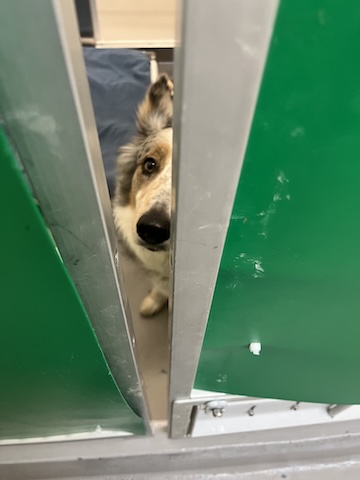
Enticing fearful dog Amy to leave her kennel with a treat
Knowledge: dog, no.
What would it mean for dogs to have real knowledge?
Knowledge, to me, implies some sort of conceptual reasoning ability, planning, or generalization that can’t be explained by any of the above capabilities. We humans can talk about all sorts of conceptual information; we can make decisions based on knowledge of distant objects or abstract concepts; we can plan for the future. Dogs can do none of these things.
Being able to perform an action is not enough: a bird can fly, but it does not know about flight any more than an airplane does (“competence without comprehension”, in the words of philosopher Daniel Dennett). (I think it would be fair to say “a dog knows how to bark,” meaning that it can bark, not that it can understand or explain barking.)
So often, we see dogs behave in ways that betray an absence of planning or reasoning ability.
For example, sometimes I play fetch with a dog that doesn’t seem to quite “understand” the game of fetch. I throw the ball for the dog, and they eagerly run after it, ears and tail high. They grab the ball and bring it back and stare at me eagerly, big smile on their face, ball still firmly in their mouth. It seems like they want me to throw the ball, but they also do not want to give the ball back, and they don’t seem to understand the contradiction. (There are other possible interpretations of their behavior here, but this is what it seems like.) Once you get the ball back, one way or another, you can repeat this this over and over. If dogs could reason or plan, they ought to predict that giving you the ball will be a lot more fun than refusing to give it up, but they will not figure this out on their own. Some dogs will learn to give the ball back with enough repetition, especially if you train them to with rewards.
Benji loves playing fetch, but does not want to give the ball back
Training is mostly about training habits, and training a new skill usually takes many, many repetitions; one rule-of-thumb I’ve heard is 100 repetitions. If dogs could reason about training, then perhaps they would be able to learn some skills faster: “hmm, it looks like this is a training session, and the human is trying to teach me a skill—what is the skill I should learn here? Aha, I got rewarded a few times now for touching my paw to his hand after he said ‘shake.’ Let me try a few other variations just to test my hypothesis.” If dogs could reason in this way, then perhaps training would be much faster.
Once learned, dog behaviors often seem automatic. It took a long time to train my dog with the “drop” command, but, now when I say it, the ball seems to fall out of her mouth involuntarily, as if by hypnotic suggestion.
I often remind myself that, not only does not my dog not know what is happening next, she does not expect to know what is happening next. If I take her to a friend’s house, she does not know if we are spending 10 minutes there, or staying for the rest of our lives. And it does not bother her not to know these things, because she does not expect to know, she has never had the experience of knowing a thing. She only experiences what is happening now, in the moment. It’s a pure moment-to-moment experience.
Reframing knowledge as behavior
An exercise that I once set for myself, and that I recommend trying out is: banish “knowledge” and related concepts from your dog vocabulary. When you want to say “she knows” something, or suggesting that she’s reasoning or planning, can you find a way to describe their actions behaviorally?
“He knows he gets a treat if he sits.” Dogs learn skills through conditioning, not through conceptual understanding.
“She knows her name.” When a dog perks up after you call their name, that does not mean they “know their name.” They don’t even know what a name is. You could not use their name in a sentence and have them understand the sentence. They have simply learned to pay attention when they hear that word, and perhaps to form expectations about what comes next.
“He knows how to get out.” During one of my first orientations at the animal shelter where I volunteer, the behavior specialist explained that we shouldn’t let jumpy dogs right out of their kennels. She told us to wait until they’d stopped jumping at the door, and to open it a little. If they start to jump or rush out, then close the door. This way, they learn that they only get to go out if they had all their paws on the ground. She said: “If he knows that he can get out when he jumps and pushes, then he’s going to keep doing it the next time someone comes by.” But the dog doesn’t know this: the dog simply jumps and pushes naturally when you’re at their door, and gets rewarded by escape.
Making sure that Matcha isn't jumping on the door before opening her kennel
Sometimes dogs learn to open their own kennel doors. These kennels are on the adoption floor and they have regular door handles. These “escape artists” learn to jump on the door handle which opens the door (if you’ve forgotten to latch the other side). One might think that the dog figured it out by some sort of problem-solving: they saw humans push down the door handle to open it and figured they could do the same. But they don’t reason this way. Instead, they naturally jump on the door out of excitement or wanting to get outside. Sometimes, they accidentally jump on the door handle when they do this, opening the door. If they do this often enough, then they learn how to open the door: they’ve stumbled into a new behavior, not found it by problem-solving.
This dog learned to open her kennel door, so it has been latched from the other side.
“She knows you’ll come back.” In my struggle to help my dog with her isolation anxiety, I’ve often heard people say my dog needs to “know you’ll come back.” But no dog that you’ve left alone knows that you’ll come back, because they cannot know things. Training dogs to be alone is about training them to feel comfortable and to settle down when they are alone. When I leave my dog with a friend, or a friend leaves her with me, she is sad temporarily about the departure and then seems to forget about it. When I leave her entirely alone, she is unhappy for the entire time she’s alone.
Why it matters
Understanding dog behaviors helps us train them better. Moreover, the more we understand them, the stronger bonds and empathy we will form with them.
When we misunderstand dogs, we often get frustrated and angry. We might feel like they’re deliberately being jerks to us. Better understanding lets us reframe these frustrating behaviors more accurately.
If a dog steals your food off the table, it’s pointless to get angry because “he knows it’s my food” or “he knows he they’re not allowed on the table.” They have no way of knowing either of these things. They’re just doing normal dog things. If you make food available to a dog with poor impulse control, of course they’ll go after it. The primary effect of yelling at a dog is to make yourself more upset.
Wrong training philosophies do get results. People have successfully train their dogs with traditional dominance-based training, based on disproven theories of “alphas” and punishment. But dominance and punishment cause all sorts of negative side effects, including creating aggression and fear in dogs, since the dogs have gotten all sorts of punishment that they did not understand or deserve. These strategies can be especially bad for dogs that start out with behavioral problems.)
Day-to-day, there’s no need to stop saying that your dog “knows” things. It’s often a lot simpler and clearer. However, it’s worth keeping in mind that “dog knowledge” is a shorthand, not literal truth.
One anecdote from trainer Kathy Sdao sticks in my memory. Sdao’s adopted a rescue dog who was sweet and gentle for months, but then he unexpectedly bit guests twice in her house. She asked for advice from several other trainers. One trainer saw Sdao let the dog on her sofa, and insisted that the bites were due to her failure to set a strict dominance hierachy. Another trainer suggested identifying the dog’s triggers: what was in common between the two bite incidents? And Sdao reflected that both bites had occurred when the she had a female guest and they were drinking red wine. This was an “aha” moment: first because it gave some clues about what the triggers were—perhaps the dog had once had an owner who became violent drinking red wine—but also a sign that the dominance-based trainers were operating out of dogma rather than looking at the evidence. By studying the triggers, she was able to manage the dog’s behavior, whereas asserting dominance would have just created more and more barriers between her and her dog, making it a less compassionate and loving relationship.
Relevance to human behavior
Human behavior is animal behavior, but with richer cognition than other animals. So many lessons from animal behavior give lessons on human behavior.
Some of us believe that we are thinking beings who also have emotions and habits, but this is backwards. We are emotional, habitual beings who also have thought. Much of our consciousness focuses on thoughts, creating the illusion that most of our mental process are thoughts.
So many of our behaviors are habitual, unthinking. If you’ve ever left your house and later wondered if you’d locked your door, then you were performing purely habitual behviors without thinking about them. Some strategies for building healthy routines and habits, involve dog-training-like strategies, e.g., reward yourself for successes.
Emotional behaviors are habitual too, like getting angry or pleased at a particular stimulus. Some dogs at the shelter are afraid of all new sights or sounds; others are eager and curious. Some dogs easily feel threatened and bark at every new sound. These are learned habits, and they have direct analogues in human behavior: think about people who are shy and fearful in new situations, including new social situations, people who are quick to anger if they feel their status is at all threatened, and so on.
If someone invites you to an event, and you cannot go, whether you respond in a positive, appreciative way, in a non-responsive way, or in a negative way, will affect the other person’s desire to keep inviting you to things in the future.
I recently heard about a friend’s relationship in which her partner was trying to do a better job at calmly expressing when he is unhappy. I asked how she responds when he does so. She said she typically gets mad. So there’s obviously some negative reinforcement there.
Bernardo: Sun's out, tongue's out.
Reading
The best book on behaviorism for animal training (and also humans) that I’ve read is: Don’t Shoot The Dog by Karen Pryor, the trainer that led the way in positive reinforcement training. B. F. Skinner was one of her mentors, and she begins the book with a full-throated defense of Skinner’s behaviorism, which amused me because of all the bad things I’d heard about behaviorism over the years.
Pryor developed her training philosophy with dolphin training at SeaWorld, and dolphins can only be trained with positive reinforcement. She then adapted those ideas to dog training, and found they worked much better than traditional training methods.
Another book that discusses dog behavior directly is The Culture Clash by Jean Donaldson. (I’ve only read a little but it seems good.)
I love my dog.
]]>AaronHertzmannWhy Drawing is Hard: Visual Limitations and the Skills to Overcome Them2026-03-23T00:00:00+00:002026-03-23T00:00:00+00:00https://aaronhertzmann.com/2026/03/23/drawing-skillsIf asked to draw a picture of a tree or a person in front of them, many people would say “I cannot draw.” Thirty years ago, two psychologists pointed out that this should be surprising. They reasoned that most people can trace over pictures easily, and most people can perceive the world accurately. So why can’t most people look at the world, perceive it, and then draw what they perceive?
Since then, researchers have extensively studied which aspects of perceptual and other skills seem correlated with improved skill at drawing, but have yet to form clear explanations for why drawing from life is hard.
In a new review paper, Judy Fan and I propose a new way to understand how people draw from life, and why it is hard:
A. Hertzmann, J. E. Fan. Artists’ Drawing Strategies Serve to Overcome Visual Processing Limitations. Psychology of Aesthetics, Creativity, and the Arts. 2026 (Advance online publication). [Preprint] [Official version]]
In the paper, we argue that drawing is hard because we humans have very limited vision and memory—much more limited than we think. We just don’t perceive the world as a picture. And so, learning to draw realistic pictures is not about innate talent, it’s about learning skills to bypass these visual limitations that we all share.
One might think that an artist looks at the world, and then draws their mental picture. But no one can draw accurate pictures this way. We do not see entire scenes this way, and we do not store complete, pixel-level pictures in our heads.
Human vision is severely limited, both in terms of what we see at any moment, and how much of it we remember, even over short periods of time. And, these limitations are not obvious—we are unaware of how much we do not see, until it is pointed out.
As an example, suppose you wanted to draw a picture of this houseplant.
Try looking at the picture, and then looking away from it. How many details do you remember when you look away: how many branches does the plant have? How many leaves does each branch have? Generally speaking, these questions are easy to answer when looking at the picture, but nearly impossible once you’ve looked away. Once you look away, the information is gone from your head. And getting the fine details purely from memory—the curvature of the stems, the precise outlines and shading on the leaves: definitely not possible.
If you were to try to draw the picture from memory, you’d be making a lot of it up, based on what you know about what plants look like.
This demonstrates the first important limitation of human vision: we remember almost no fine visual details. We don’t store pictures in our heads like they were JPEGs.
We do remember things about the pictures we’ve seen, but not at the level of detail necessary to accurately draw them.
Here’s the second thing to try: stare at one leaf on the plant, and then, without moving your eye from that leaf, try to answer those questions again (how many branches? How many leaves?). Again, if you fixate your eyes only one spot on the plant, then you get very little detail about the rest of the plant. Again, you couldn’t draw an accurate picture of the plant just staring at one leaf.
This demonstrates this second important limitation of human vision: we get very little detail in peripheral vision, that is, in directions that we’re not looking. As another demonstration, try staring at one word in this paragraph, and, without moving your eyes, see how many other words you can read. The answer will be almost none.
Moreover, not only do we see and remember very little, we’re really unaware of this; we tend to think that we’re seeing everything in front of our eyes, but this is an illusion. I’ve written much more about this illusion and provided surprising demonstrations about at that link. I have also written about how these illusions determine how we use and perceive perspective in pictures.
Once we understand these limitations of human vision, then a whole lot of things about how people draw begin to make sense.
Eye movements in drawing
“When you draw from the eye, you’re drawing from memory. A memory of five seconds ago, a memory of ten seconds ago, a memory of a minute ago.” —David Hockney
Here’s Henri Matisse drawing a picture of his grandson. He doesn’t just look at his grandson once and then draw from memory. Instead, watch how much he moves his eyes back and forth between the drawing and his grandson:
What exactly are his eyes doing?
Here’s another video of a person copying a picture, but this time recorded with an eye tracking device. The black rectangle show where the his eyes are looking at any moment.
The artist’s eyes are continually going back and forth between lines in the drawing and the lines in their copy. In both videos we see that drawing from observation involves near-continual eye movement between the source and the drawing.
Why? Given the limitations of human vision that I demonstrated above make it obvious. Consider just copying a drawing. If the brain can store only very little detail at a time, then you can’t remember a detailed version of the source picture or your copy. You continually moving your eyes back-and-forth to gather information from the source and then see where to put it in the target. It’s a bit like trying to transfer water between two pots using only a leaky teacup.
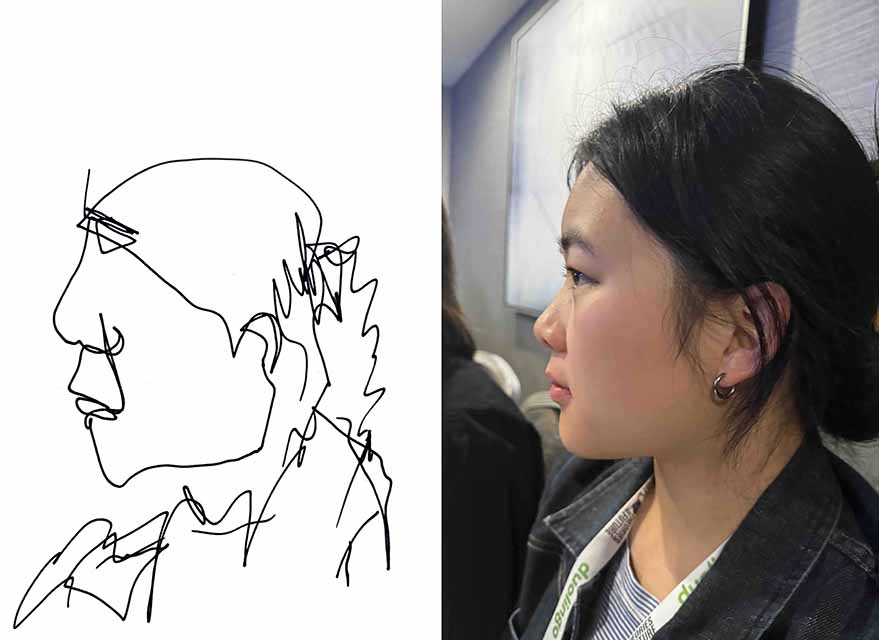
What happens if you restrict eye movements? One common drawing exercise is called “blind drawing,” in which you are not allowed to look at your drawing, only your subject. Here’s an example of a blind drawing that I made at a workshop, where we were given 30 seconds to draw the person next to us using a single line:
(I took the photo a moment later.) The “errors” are typical of blind drawing: individual shapes are accurate, but their relative proportions and positions are way off. I drew her eyes, nose, and jawline first, then her hairline, but, by the time I got to the hairline, I didn’t know where my pen was relative to the her nose and eyes, and so I put her hairline right over her eyes.
When trying to do life drawings for the first time, beginners tend not to look at the source very much; they spend most of the time looking at their drawing. As a result, they can’t get many details very accurately simply because they never see them. One study found that requiring novices to look at the subject more frequently improved their copying accuracy. Blind drawing is also an exercise often giving to beginner students.
Learning to draw, as they say, is partly about learning to look, and, to start, that can simply mean spending more time looking.
Drawing is a set of skills
Everyone shares these visual limitations. Learning to draw is a matter of learning skills to work within these constraints. Artists develop a range of different techniques, strategies and skills for all parts of the drawing process. Here are just a few examples.
To draw simple lines and curves, the “target locking” technique for drawing an individual line is to position your pencil at the start of the lines, fixate your eyes on the end of the line, and then draw to where you fixate:
Nobody teaches you to do Target Locking, and nobody does it intentionally. In fact, almost no one knows about it, even if they do it all the time. Target Locking is a description of behaviors observed in a few eye-tracking studies. People are not good at being very aware of how their eye movements operate. (Another behavior, from the same study, is “smooth pursuit,” where the eyes follow the pencil.)
A more high-level example. Here’s a simple fact: a person’s eyes are half-way between the top and the bottom of their head. Yet, often our drawings don’t come out that way. Here’s a sketch that I recently drew for a paper figure:
There are a few things to point out here:
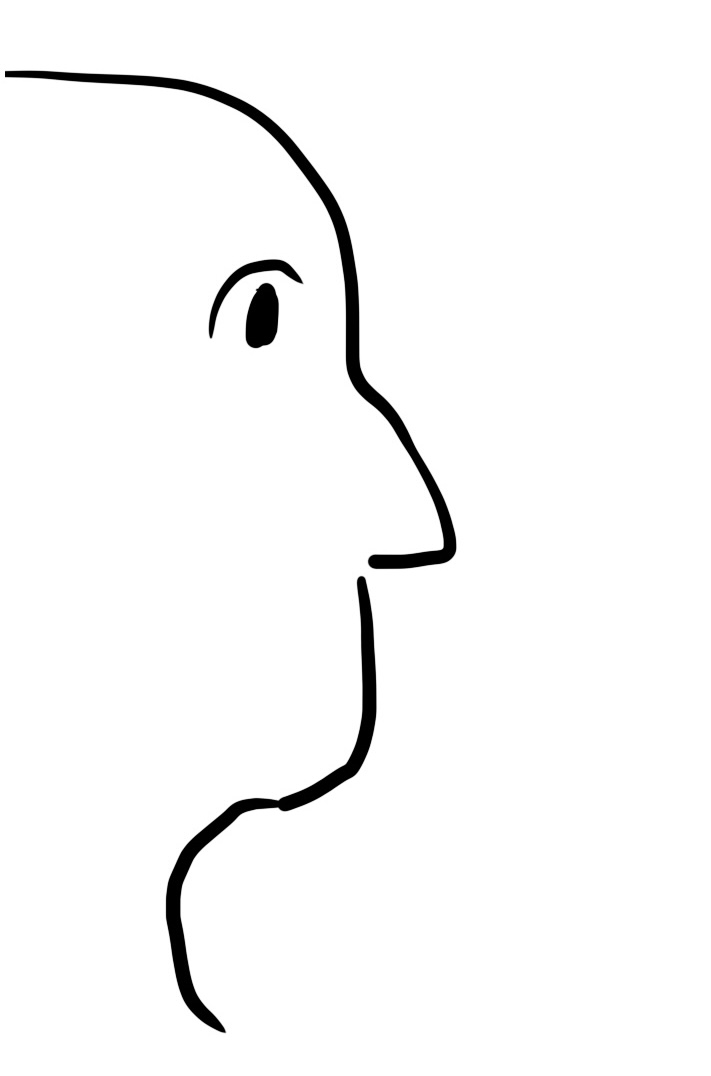
The cartoon character’s eyes are almost next to the top of his head, which would look totally wrong in real life.
You might not notice this anatomical mistake in the cartoon unless it is pointed out.
I know this anatomical fact, and yet I still made the mistake.
I don’t care about the mistake; I’m perfectly happy with this cartoon. I don’t consider it a mistake; I think the cartoon looks fine without anatomical accuracy.
But if this were part of an initial sketch for a more-accurate drawing, then this would be a problem, and one might not notice the problem until much later.
This knowledge can be useful for drawing: one study found that informing novices that the eyes are in the middle of the head improved their drawing accuracy. This conceptual knowledge can help you make conscious judgements to improve your drawing. This is why realistic artists sometimes engage in careful studies of anatomy.
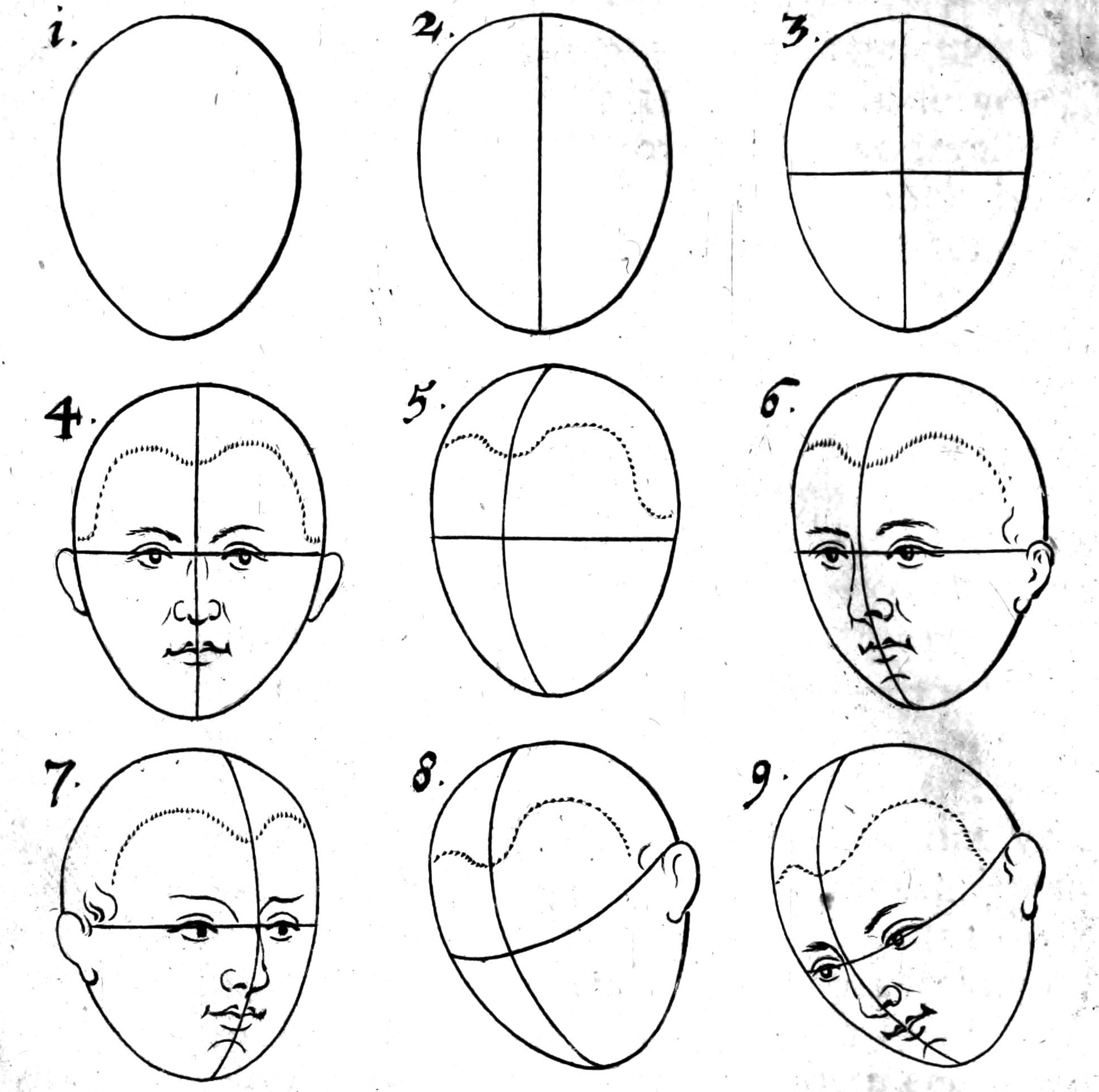
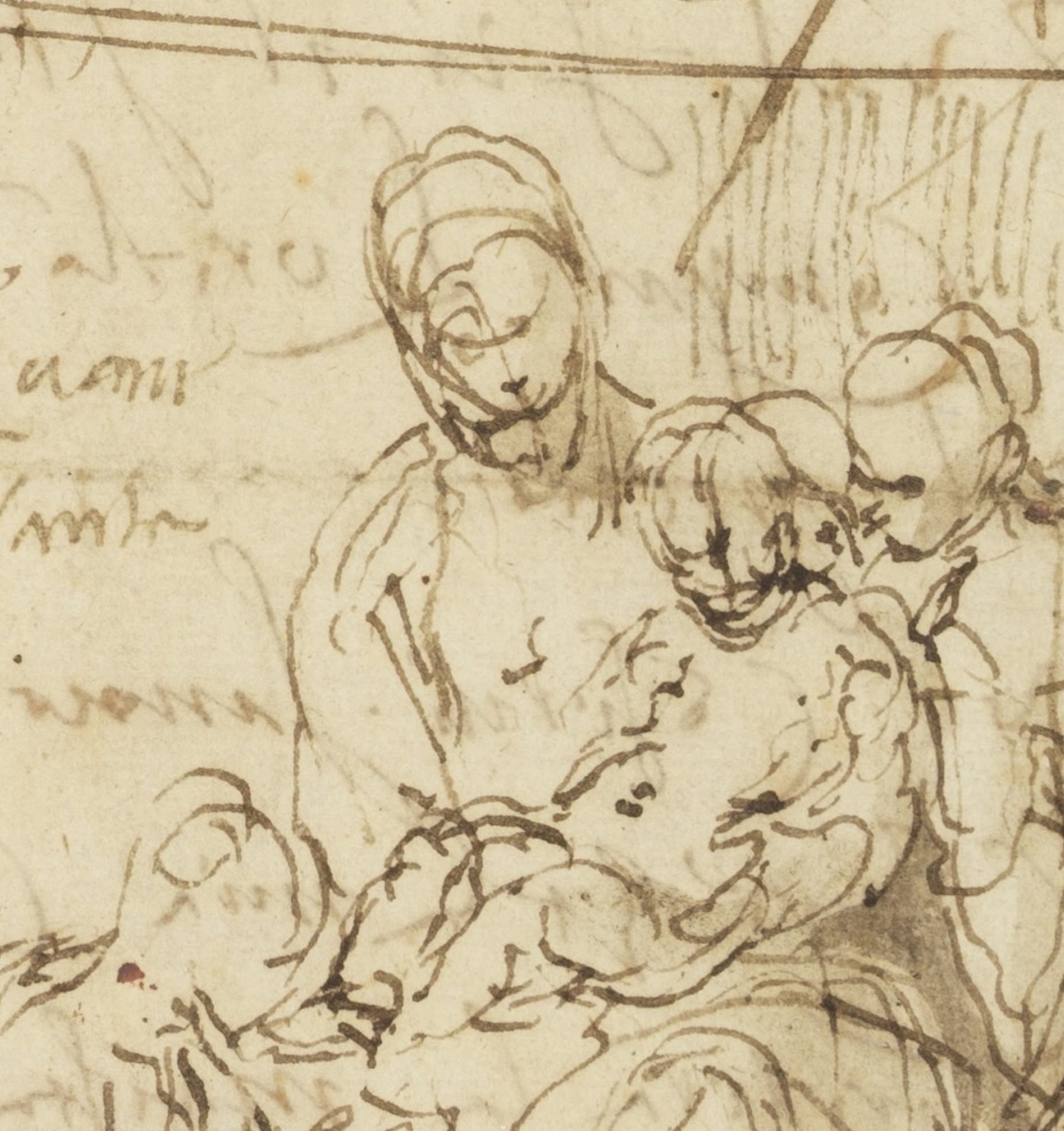
Here’s an explicit technique that you can use to draw faces and avoid this problem. First, draw an oval for the head, then a cross to indicate gaze direction, like in these examples:
How to plan faces as ovals, by William Goeree, 1688, and use of this technique in sketches by Paolo Veronese, 1568
People have created all sorts of more-elaborate such rules for other kinds of drawing, including one-point perspective and two-point perspective, and rules for drawing full bodies, which has led to some great parodies.
In the paper we survey many other kinds of strategies and skills that artists learn.
Anyone can learn to draw
In Western culture, we’re taught that artists are some sort of special geniuses with innate talent—you’re either an artist or you’re not—a belief that only dates back to 18th-century Romanticism and misguided educational philosophies.
This mystical nonsense prevents people from learning to draw. But all you have to do is take a chance and try it out. I personally have known so many people who took a drawing class or worked from a book of exercises and went from “I can’t draw” to “Wow, I drew that?”
Our work suggests some reasons why people might mistake the inherent difficulty of drawing with innate lack of talent. We’re unaware of how limited our own vision and visual memory is. So it’s like there’s this invisible mental block—limitations of vision and the illusion of awareness—and we think that it means “I’m not good.” But simple exercises can help you start to work around this mental block. Once you understand the block, it makes more sense.
Drawing is a skill you learn, not an innate talent. I think there are only a few things you need to learn to draw: a little bravery, some exercises (especially from a book or from classes), and lots and lots of practice. I wrote a little more about this here. Just a little time and practice can make drawing an engrossing pursuit that enriches your life and becomes its own reward.
]]>AaronHertzmannTechnology and Social Isolation: From Cars to “AI”2025-10-26T00:00:00+00:002025-10-26T00:00:00+00:00https://aaronhertzmann.com/2025/10/26/isolationIn this blog post, I tell a story of how some technologies from the past century or so have, overall, led to increased social isolation in the United States, as we replaced in-person social interactions with technology.
We can divide social relationships into three categories: close ties, like close friends and family; weak ties, like coworkers and casual friends; strangers, like people you might pass on the street. All three kinds of social relationships are important, and this post is about ways that technology has transformed each of them in the past century.
Technology often benefits our social relationships, in ways that are often obvious. The negative effects are less obvious, which is why I focus more on those. I use and enjoy every category of technology discussed in this post: I love listening to recorded music; I use my smartphone and/or laptop all the time; I love connecting with friends and colleagues on social media. I don’t believe any of these technologies are “bad,” but they are not “neutral” either.
Cars: from villages and cities to highways and suburbs
Automobiles are the Original Sin of 20th-Century American social isolation.
Isolation always existed throughout history. But, by the end of the 19th century, many people many lived in communities where they saw their families, friends and neighbors as part of their daily lives, whether farming villages or larger cities. Even poor immigrants overcrowded into New York City tenements often lacked basic needs but frequently had each other.
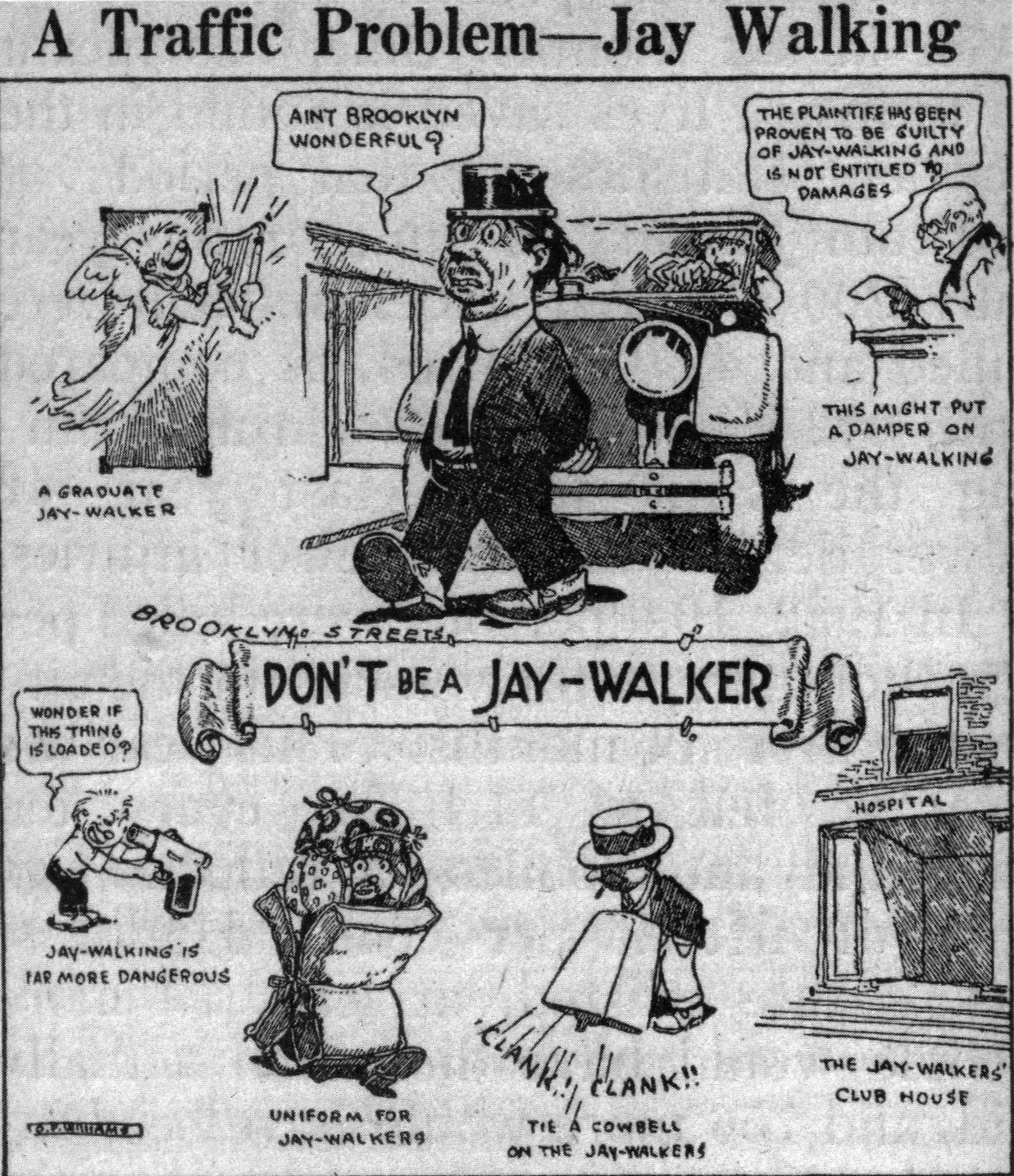
Henry Ford’s invention of the mass-produced automobile—and the powerful automobile industry that grew around it—radically affected the 20th century development of American cities. Before the rise of the car, city streets were public spaces for everybody: pedestrians, horses, children playing. Automobile manufacturers began a program of remaking cities for cars, through ad campaigns to stigmatize pedestrians in roads as “jaywalkers”, lobbying for laws against jaywalking, and lobbying for more roads. (“Jay” is old-fashioned slang for a country bumpkin; calling someone a jaywalker is like calling them an idiot.) Public transportation and walking became less-and-less practical, leading to a vicious cycle: more and more people drove cars, and then demanded more roads. And, when cars hit pedestrians, pedestrians were blamed.
Cartoon from a 1923 campaign to convince people that walking in the street is bad.
Automobiles offered freedom and independence: convenient ability to travel far, whether for work or reaction. They signalled social status, wealth, independence, and manhood. They became popular, and then mandatory.
By the 1940s, a generation of urban planners favored cars as the primary mode of transportation. Most famously, New York’s transportation overlord Robert Moses grew up wealthy and never learned to drive, yet rode in cars his whole life. He built a staggering number of roads, highways, and bridges around New York City and Long Island, while blocking decades of public transportation projects.
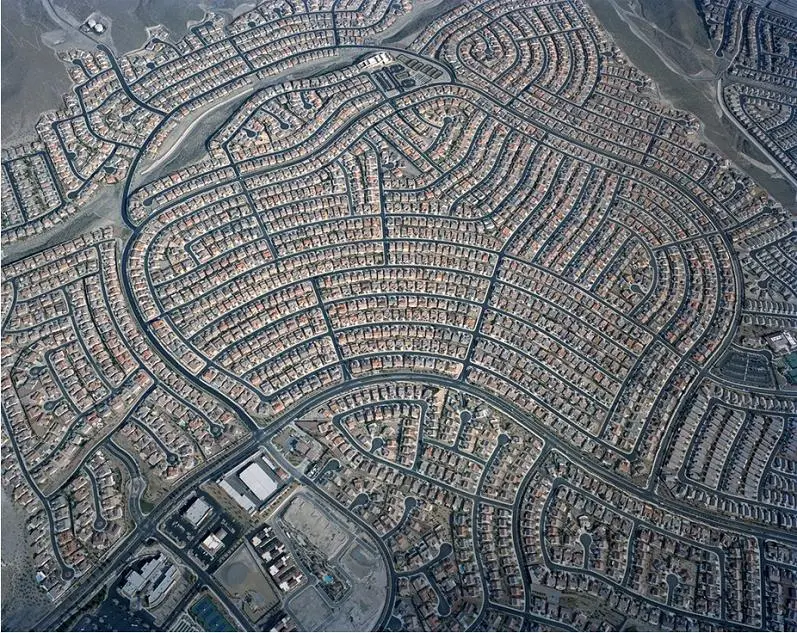
Throughout the US, a new kind of population center arose: the “suburb.” Suburbs allow people to have big houses outside of the cities where they worked. Zoning separated houses from businesses, and large houses were separated from each other, creating massive urban sprawl, and making driving mandatory for most activities in many suburbs.
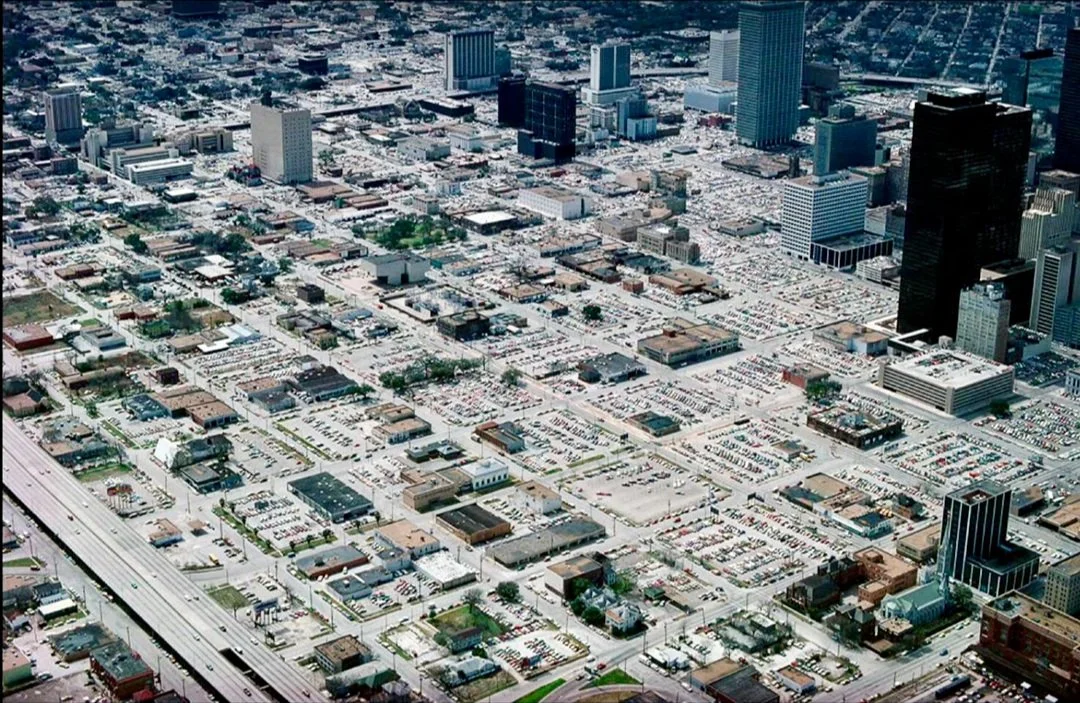
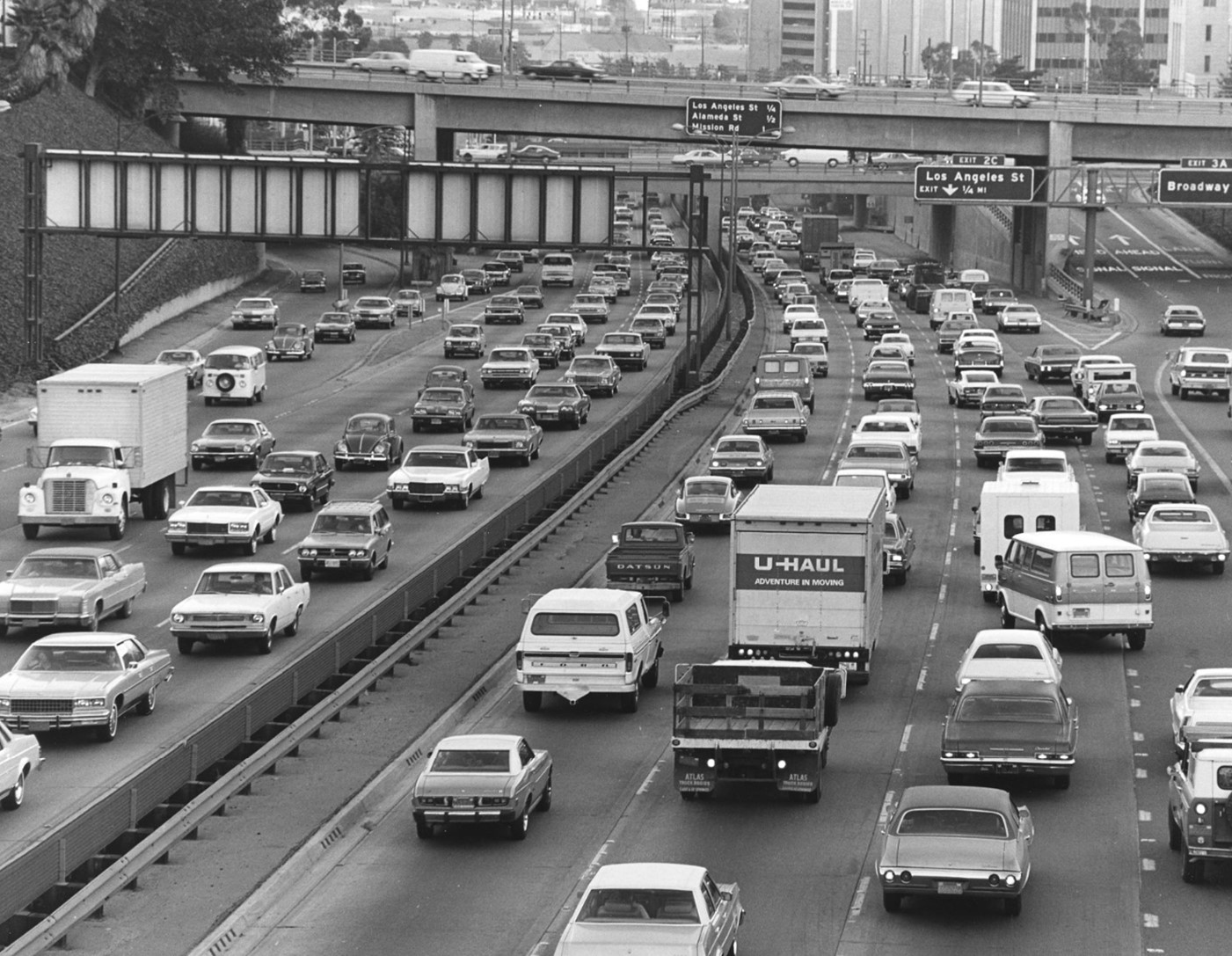
By the 1970s, the terrible consequences of our car-first policies were clear: intense traffic jams on highways; smog that considerably shortened peoples’ lifespans; racial segregation; urban blight; unhealthy lack of exerise when people drive everywhere; dependence on foreign oil, as highlighted by the 1970s energy crisis.
Los Angeles traffic and smog in the 1970s
Since then, we have undone some of these ills. Emissions regulation mostly eliminated smog; alternative energy modes have reduced dependence on oil; many cities now favor mixed-use urban planning, while investing in bike lanes and public transportation. A few urban highways have been removed, like San Francisco’s Embarcadero Freeway and Seattle’s Alaskan Way Viaduct. But the flywheel of highway demand still drives much of the politics: car drivers, stuck in traffic, continually demand more road in the intuitive but utterly wrong idea that adding roads reduces traffic, and fight against any attempts to share the roads with more-efficient transportation modes.
Car culture and social isolation
But when it comes to social isolation, I think most people still don’t realize just how much our car-first culture has hurt our connections with other humans.
After all, cars seem empowering: if you want to go see friends, go to a restaurant or bar, go to see live theatre or sports… why, you just get in your car and drive there. The car makes it possible! But American urban planning made the car necessary for most of these activities.
Car-first culture reduces meaningful encounters with strangers. As Joe Keohane describes in the surprisingly-deep The Power of Strangers, interacting with strangers and acquaintances creates a sort of societal glue: not only can it improve your own mental well-being, and help you make connections, it ties us together in a community. Even walking down the street, you have passing interactions with strangers; depending on how segregated the society is, you could be passing a cross-section of humanity. It’s much easier to feel some level of empathy for people that you interact with casually, in person. Interactions with strangers has played an important role in human evolution and in many ancient cultures.
When we travel by car, we self-segregate ourselves from all other humans, with virtually no direct interaction beyond fleeting eye contact. Our interactions with others often create stress, and more anger than empathy.
For most of human history, social interactions outside of the home was built into daily life: daily activities naturally involved seeing people. In the suburbs, you can drive to places to interact with people, say, driving to churches, meetups, bars, or public events. You have to make an effort to have interactions with people, as a separate part of your day. Like driving to exercise at the gym.
My father was born in San Francisco, as was his father. After World War II, they moved to the suburbs, like many of that era. My father stayed in the suburbs until retirement, and then moved into a retirement community back in San Francisco. He said ruefully that it was the first time in his life that he felt like he lived in a “neighborhood:” a community where he interacted frequently with his neighbors.
Many seniors choose to stay in their suburban homes throughout their old age, becoming increasingly isolated as their mobility diminshes, leading to increased loneliness, in turn, worsening dementia and other health problems.
Social isolation is particularly bad for children, as I’ll come to in a bit. But first, some parallel developments in entertainment.
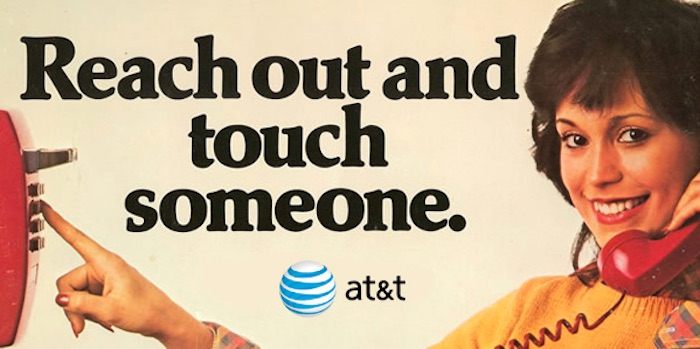
Telephone technology (and cars) presented as a solution to the problem of friends that live far away
Entertainment: From performance to recordings to video games
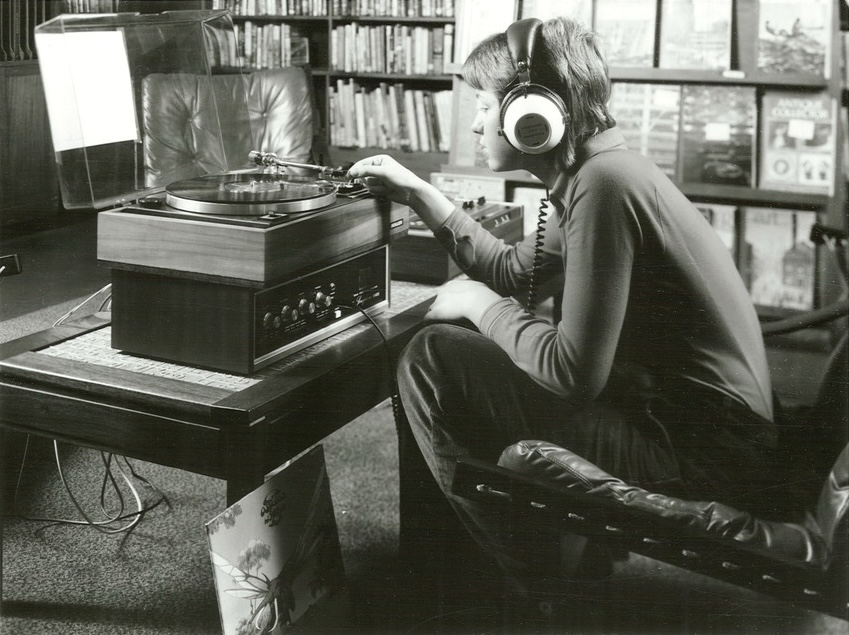
Throughout most human history, social groups made music together: families played instruments together in their living rooms and porches; city dwellers sang together in taverns; churchgoers sung hymns and gospel together.
In fact, social musicmaking predates human history. Savage et al. survey a range of anthropological evidence that social bonding is the reason why we have music. Music performs important social functions for how we relate to our fellow humans around us.
At the start of the 20th century, Edison invented the first music recording device: the wax cylinder. You no longer had to be in the same room as a performer to listen to music. Recorded music grew in popularity, and, through many formats since (tape reel, vinyl record, cassette tape, DVD, mp3, streaming), remains a huge force in our culture today.
Recordings allow you to develop a sort of relationship with a performer. Sometimes we feel like they’re directly communicating with us. It’s a one-sided, parasocial relationship, but a relationship nonetheless.
With the development of music recording, radio, cinema, and, then, television, communal music-making diminished. Why go through the trouble of learning instruments, getting your amateur friends together, picking a song, and playing it, when you can listen to a recording of some of the best music in the world? Or watch amazing artists perform on television or online?
Many 19th-Century living rooms focused on a piano. By the time I grew up, most living rooms were focused around the television; the living room of one of my high school friend’s centered around an enormous television that we called “The Shrine.” Watching television together can still be a communal activity. Sometimes the show is a reason to get together. But you can also enjoy music and TV alone.
Around the 1980s, home computers and video game consoles appeared. These could also be social—going to a friend’s house to play games together—but one could also spend many hours alone with computers and video games. You no longer needed another person with you for playtime; the computer could be your play buddy. In the suburbs, this was a whole lot easier than actually finding a friend in person. Online gaming and the Internet added social elements, with email, BBSes, Usenet, and then the Web. So you could socialize and play alone, or with friends and strangers online.
With the Sony Walkman, recorded music went into our pockets, we could be out and about, with headphones separating ourselves from the world.
In the early 2000s, computers went into our pockets: with mobile phones, and then smartphones. Now each person carries their own television, cinema, game console, and Internet device around in their pocket. Each person at home or out and about can be in their own separate world of games and passive entertainment.
Children: From free range kids to social media
Let’s come back now to the car-first suburbs, and its effect on children.
As I understand it, children in pre-1970s villages and big cities used to roam freely together for unsupervised play and exploration. Think of the adventures of Huck Finn and Tom Sawyer, or so many other fictional children that explored and played outdoors, unsupervised. The suburbs made this increasingly difficult for many kids.
As a suburban Gen X-er with working parents, I was a latchkey kid who, every afternoon, came home from school alone and stayed at home alone until dinnertime. My closest childhood friend lived over a mile away from me, which, for a kid, was quite a long distance. So we saw each other some days and not others. My other friends lived even further away, and it’s hard to be close with someone you don’t see often. I had a bike, but no interest in using it, which I attribute to a lack of role models, since adults never biked.
My social circle only became really active toward the end of my childhood, once we were old enough to drive, and suddenly groups of us could go do stuff together most evenings and weekends.
A series of “stranger danger” panics made things worse. We were told not to talk to strangers, who might take us away in a white van for unspoken purposes. In essence, we were taught to see every stranger as a mortal threat. But the threat was vastly overstated: stranger abductions were quite rare, much rarer than children dying in car crashes.
Yet, this perceived threat led to seismic shifts in childhood for generations of children. Because of “Stranger danger” fears, millenials were often not allowed out unsupervised alone at all, while helicopter parenting led to a decrease in unsupervised play time entirely. A compelling article by Gray et al. (official link) surveys extensive sociological and psychological evidence that losing unsupervised play time led to an increase in mental illness among millenials.
Children raised in a bubble will struggle outside of the bubble, sometimes for their whole lives.
Since millenial kids had less opportunity to socialize in person, they turned to early social media sites like MySpace and Facebook. Parents responded with another moral panic, fearing the effects of social media on their kids. But, as danah boyd found in her ethnographic studies, these kids were just playing out all the usual teenage social dynamics online. In this case, technology replaced many of the social interactions that these kids were denied in person.
Internet: From social media to “AI”
In the 2000s, social media—Facebook, Twitter, Instagram—became one of the main ways that we interacted with other people in society. More and more, we interacted with our friends, with strangers, even with celebrities online. As newspapers fell to the one-two punch of private equity and Internet competition, we began to get more of our information about the world from social media sites.
Online affordances have long been blamed for a lack of online civility:
When you don’t see someone in person, it’s harder to have empathy for them. It’s hard to communicate in a considerate way. It’s easier to be misinterpreted. And it’s a continuum: a Tweet is worse than a Zoom call, but a Zoom call is still worse than physically meeting in person.
By the 2010s, America’s polarization reached a crisis level of dysfunction, and many people blamed polarization on social media. I blame propaganda machines (Southern strategy, talk radio, Fox news, etc.), but social media really greased the wheels. In these semi-anonymous online services, messages from your neighbors, from people who share your own values, from political operatives, and from Russian state sources could all look the same and carry the same weight.
By the COVID lockdowns in 2020, we had adopted online technologies so thoroughly that it was fairly straightforward to retreat indoors and conduct all of our interactions with other humans electronically. Electronic communication became a life-saver, literally. But we suffered for the isolation, especially children. And, when we did see each other in person during the pandemic, and, then, when we first came back out into world, to our first restaurants, concerts, and parties, we briefly felt just how valuable and important it was to be out with other people.
As someone who has worked in “AI” research for many years, I find the new technologies amazing and wonderful; it’s so cool and fascinating that they work. A few of the times I’ve tried it, ChatGPT has given me correct answers to questions where all other avenues I’d tried had failed. I’m excited about the way new technologies continually revitalize art.
But new “AI” technologies also extend and amplify all of the threats to our social relationships, mental health, and social fabric. In the most basic sense, even casual interactions with customer service is being replaced by chatbots. We hear of professional writing often replaced by text generation (e.g., scientific paper reviews, law briefs); professors get messages from their students that look like personal communications but were obviously written by chatbots. Even more, we’re hearing stories of people forming intense personal relationships with “AI” chatbots—in a sense, fully replacing human interactions with technological interfaces.
More and more, we won’t even know if the words and conversations we see online were written or spoken by a person, further diminishing our trust and sense of connection to the people in our society.
Does modern technology generally lead to isolation?
Did all of these technologies make us less social? Are there any common lessons and themes? Do automobiles and social media have anything in common?
First, it’s worth repeating that technology does not cause isolation. Technology does not cause anything. But it shifts the scales of what is easy and what is possible.
Moreover, it’s worth repeating that these technologies have a complex impact on our social relationships. If you live in a suburb, then having a car will be very important to having in-person social relationship; you can’t get by without it. So, in that immediate sense, having a car enhances your relationships. Likewise, social media lets you connect with friends and family in a way that you might not otherwise, especially when you live far apart from them. But, by virtue of making it easy to connect when we live far apart, they make it easier to live far apart, creating a vicious cycle.
As technologies get better, they automate many interactions that previously required a human.
A 19th century shopper might buy their meats from a butcher, and vegetables from various markets. They would have to travel to different sellers in their neighborhood, a time-consuming process; they might also form casual relationships with each of them. Then, as canned food became more commoditized, they were sold by grocery stores: you’d go to the grocer and tell them what you wanted, and they’d get your food from the shelves. In 1916, grocery stores became self-service: you find what you need and bring it to a human cashier with whom you’d exchange pleasantries. Starting in the 1990s, self-checkout machines meant no human interaction required. Then, delivery apps allowed you to order your groceries online: you could get all your food delivered without even leaving your house. No-contact deliveries in the pandemic meant you might not even see the delivery person. This made grocery ordering fast, easy, and without the least bit of human interaction. Some services are now testing and deploying food delivery robots.
We can repeat that kind of story for many other kinds of activities, that have, over decades, moved from time-consuming, in-person interactions to convenient, human-free apps.
Our online social interactions often have a lot of the same feel and elements of real in-person interaction. Phone calls are a great way to keep in touch, and I still treasure my regular calls with close friends. Watching social media lets you enjoy and participate in a great online conversation; I’ve learned a lot and had many meaningful interactions with colleagues and acquaintances online.
But watching social activity online is a bit like eating junk food. Junk food has the sweetness, umami, and/or saltiness that tells our animal brains that we’re consuming something nourishing. But it is not nourishing. Likewise, social technologies give us some of the elements of social relationships, without the same nourishment. Eating a bag of potato chips, or scrolling influencers on TikTok may be pleasurable, but they are unlikely to leave you feeling nourished.
One could extend the argument backward through history. When I mentioned my thesis above with some colleagues recently, one of them described books as socially isolating, and the others agreed (one described all the time her child spends reading). The industrial revolution was enormously alienating to generations of people who became mineworkers and factoryworkers, toiling in inhuman conditions for most of their waking hours. Or surely, one could say this about war technologies and surveillance—or heck, even the development of agriculture millions of years ago. If we view Pleistocene hunter-gatherer tribes as our ideal state, then every technology development has moved us away from that state, starting with the development of agriculture. But this does not seem like a productive argument.
How to Counter It
We are social creatures, evolved to live in small tribes of hunters-and-gatherers; all of our social behaviors, in some way, can be traced back to our Pleistocene ancestors. In-person interactions with neighbors and with strangers is one of our most basic needs, like food, health, and physical safety. And yet, we live in a modern world, with its complex demands and structures, and we’re not going back to our hunter-gatherer lives.
I still enjoy television, video games, social media; I daily use telephone, email, and instant messaging to keep in touch with close friends, family, and coworkers; I sometimes order food and products with delivery apps; I ride in automobiles when necessary, etc. In our modern world, each of these technologies can benefit our social relationships and other aspects of our lives. And, even if we wanted to give up these technologies, we live in a society in which doing so would be very hard. Their underlying problems are societal problems that we cannot solve alone.
However, I recommend taking stock of which relationships are valuable and/or nourishing. And, what kinds of interactions support those values? How do you feel after an evening with friends, versus an evening scrolling social media? I believe you will find that the in-person interactions are the most valuable, lead to the greatest connection and empathy. These are worth prioritizing. How can you organize your life to best support the things that matter (such as meaningful relationships) and not the things that don’t matter (sitting frustrated in traffic; scrolling social media)?
Moreover, in-person social interactions with strangers, though often fleeting, can really enhance our sense of connection with the larger society around us.
It takes conscious time and effort–and sometimes, resources—to avoid the noise and figure out what really matters.
Some readings I recommend
Derek Thompson. The Anti-Social Century. The Atlantic. 2025.
Thorough and well-researched article that makes many of these points, and more (sent to me after I posted this; thanks, Moshe Vardi).
Joe Keohane. The Power of Strangers: The Benefits of Connecting in a Suspicious World. Penguin Random House. 2022.
A surprisingly deep exploration of the value of talking to strangers, through anthropology, sociology, and psychology, and how talking to strangers is important both personally and societally.
Amy Orben. The Sisyphean Cycle of Technology Panics. Perspectives on Psychological Science. 2020.
How moral panics recur over each new technology, and waste time and resources by misunderstanding the new technologies.
Jane Jacobs. The Death and Life of Great American Cities. Random House. 1961.
The influential and insightful account of how mid-century American urban planning fails, and how cities can function successfully.
This post was inspired, in part, by conversations with Moshe Vardi. Thanks to Steve DiVerdi and Obie Pressman for comments.
]]>AaronHertzmannHow “AI”-Generated Imagery is Different From Previous Art Technologies2025-10-25T00:00:00+00:002025-10-25T00:00:00+00:00https://aaronhertzmann.com/2025/10/25/indistinguishabilityWhen text-to-image generation became big in 2022, many people reacted in shock. I heard a lot of people saying that nothing like this had ever happened before.
Even if all new technologies have a lot in common, they also must have differences. But what are the relevant ones for “AI”?
Certainly the fact that many popular “AI” models are trained from scraped datasets is important in some way, but that alone does not indicate its impact on the arts. Internet search engines are also built and trained from large scraped datasets in ways that can affect the arts.
First, the historical analogies help us overcome cognitive biases. Our gut reactions to change are often wrong, and historical examples help us see this, and help us better understand the real dangers. For example, a natural response is to try to protect existing artists is to expand copyright, but this requires caution since overbroad copyright has a long history of hurting artists.
Second, if you want to convince people, then you need defensible arguments. For example, Ted Chiang’s argument against “AI” as art seems not to have been informed by any knowledge of the history of photography or conceptual art or computer graphics or the way algorithms make choices or current developments in interactive tools. His piece will not persuade people who know about these things. His piece could have been a good argument that text-to-image is not a good artistic tool, something I agree with, but that’s not the argument he claimed to be making.
One possible difference is that the tools became effective much faster than with previous technologies. Portrait photography took decades to become widespread, and consumer photography took even longer. But it’s hard to judge speed in the moment, amongst all the breathless hype and controversy; some claims of the immediacy of “AI”’s actual impact may be overstated.
The biggest difference
After a recent talk that I gave, a student in the audience pointed out a way to phrase the difference that I think may be important.
Nissim Maruani wrote to me that: “for the first time in history, human and machines are actually creating using the same art medium … what does art become if the spectator cannot distinguish generated and human-created content? More literally, what would be the incentive for a human artist to publish on Spotify if the public cannot distinguish their work from free, on demand, and even maybe personalized music?”
In short, the new tools are different in that, not long after invention: it is often impossible to tell how generated imagery, video, audio was created.
Was it hand-drawn, digitally painted on a tablet, or generated by algorithm? There are some telltale signals (weird physics, extra fingers appearing), and various stylistic clues but it’s often very hard to say for sure. To some extent, telling the difference may be possible with expertise and connoisseurship, although this can often be misled
In contrast, early photography was never mistaken for painting. You would rarely listen to recorded music and think that it’s a live performance (exceptions include lip sync). Early computer animation looked nothing like live action film or hand-drawn animation.
So, unlike a lot of the gut-response objections, I believe that this Indistinguishability one is valid, and worth considering the implications of.
I am not claiming that the idea is new, but that this is a defensible way to describe how these technologies differ. People have been discussing the implications of this fact, even if they might have phrased it differently. And, I think this is something that was missing from my previous discussions of the topic.
Here are some possible takes.
One take is “AI slop” “crushes creativity”, by making all work meaningless when we can’t tell any of it apart.
Culture theorist W. David Marx has argued that cultural value has already stagnated for the past several decades, and that “AI” merely accelerates this trend: “less value is created when all cultural artifacts are procurable with enough money, can be made anywhere by anyone, and offer no useful social distinctions between philistine and aesthete,” fulfilling an “extinction-level destruction of cultural value” predicted by the Postmodern philosophers decades ago. He further predicts “a re-evaluation of real-life experiences”… maybe we’ll get away from our screens more, if online cultural activities offer less status or meaning?
I do believe that history shows that the best art requires human authorship, experience and connection; we care about art because it is made by humans. Improved tools raised the bar for the best art. But there are many areas where we may not care so much, and these are the areas that “AI slop” inhabit.
I also think the analogy to photography remains useful: photographs didn’t look identical to paintings, but they were close enough to radically challenge the existing notions of the value of creating realistic pictures. Once photography grew widespread, making realistic pictures was no longer valued in the way it had been when it required a painter’s skill. The subsequent Modern Art movements reversed the understanding of artistic skill and talent in the contemporary art world; in Van Gogh’s words, recreating reality was “just photography”.
Mass culture still values skill in a way that the contemporary art world does not. Perhaps mass culture will go through a similar transition.
A post online asked for critique of an AI generated Monet-style paimting, and got tons of explanations of how bad it is. But it's actually a real Monet panting (Water Lillies, 1915).
Thanks to Kabir Ahuja for comments and pointing out the link to digital cinema.
]]>AaronHertzmannThe Menace of Mechanical Music: Was John Philip Sousa right?2025-09-30T00:00:00+00:002025-09-30T00:00:00+00:00https://aaronhertzmann.com/2025/09/30/menace-of-mechanical-musicIn 1877, Edison introduced the phonograph cylinders, the first musical recording media. For the first time in history, you could listen to music without being in the same room as a performing musician. And, soon, some people hated it.
In a 1906 essay entitled The Menace of Mechanical Music, the popular composer John Philip Sousa warned “I foresee a marked deterioration in American music and musical taste, an interruption in the musical development of the country, and a host of other injuries to music in its artistic manifestations, by virtue—or rather by vice—of the multiplication of the various music-reproducing machines.” In short, he predicted, recorded music will be disastrous for music and our musical taste.
Today, it’s easy to laugh his bonkers predictions, like that mothers will turn their children into soulless machines by playing them soulless recorded music instead of singing their children to sleep. We take music recording for granted, and surely we still have pretty good taste. It’s hard to imagine wishing that records, CDs, and mp3s had never been invented. So it’s very easy to dismiss his doom-saying.
But, the more I’ve thought about it, the more I think that he had some good points.
These days, many people predict artistic doom from our new technologies, and it can be easy to dismiss these predictions, sometimes by pointing back to older predictions of doom. But it’s helpful to look back at the ways that old technological changes did change everything, both in good and bad ways. Doing so can give hints as to how best to navigate new changes.
Was John Philip Sousa right in any way, and what lessons, if any, does his example contain?
Soullessness
Sousa first argues that music must express the performer’s “soul.” “The nightingale’s song is delightful because the nightingale herself gives it forth.” Hearing music from a machine, and “reducing the expression of music to a mathematical system of megaphones, wheels, cogs, disks, cylinders,” robs music of its soul.
As someone who has spent their life listening to recorded music at home—and, often, fallen in love and feel deeply connected to musical recordings—I just think he is wrong about this. It is true that there is really something special about seeing music performed live, but recordings also create deeply meaningful experiences, and a sense of connection with the artist.
Musicians long ago began making records meant to be heard as records, whether we’re talking about music concrète, The Beatles and Pink Floyd composing with tape loops, AOR rockers, densely-composed rap albums like “Fear of a Black Planet” or “Paul’s Boutique,” or EDM musicians like DJ Shadow and Amon Tobin sampling and reconstructing bits of other recordings, and so on. Recording has enabled new kinds of music that we now cherish.
Listening to a recording is more like reading a novel, rather than listening to a storyteller read live. And, like a short story or novel, you can study a recording, and go back to it over and over, in a way that you cannot with a perfromance.
Sousa writes “I could not imagine that a performance by it would ever inspire embryotic Mendelssohns, Beethovens, Mozarts, and Wagners to the acquirement of technical skill, or to the grasp of human possibilities in the art.” In this he is utterly wrong.
So many of our current musicians talk about being inspired by recordings. In the words of one artist: “The first Velvet Underground album only sold 10,000 copies, but everyone who bought it formed a band.”
Whenever someone says that machine-made art is soulless and cannot compare to human art, they should consider whether they are basically making the same argument as Sousa’s, or the complaints that artists once made against photography, or against computer graphics, and so on.
In 1906 a famous composer warned recorded music would end lullabies and turn kids in human phonographs "without soul or expression"
But, on the next point, I think Sousa was right on.
Sousa wrote “The time is coming when no one will be ready to submit himself to the ennobling discipline of learning music.” In short, he wrote that people would not learn to make music because they could just listen to recordings instead of making it themselves.
He throws out many instances of camaraderie in people making music together that, individually seemed old-fashioned and absurd when I first read it. People gathering around a campfire won’t tell stories or play music, they’ll just listen to recordings! But, taken together, I think he did have a real point.
In contrast, when I grew up, at the center of most living rooms was a television. I never learned an instrument so I’ve never experienced it myself. I’ve only been around friends playing music on a handful of occasion, but, these occasions seemed magical. I’ve heard from several people that singing together in groups and choirs is a powerful bonding experience.
For most of us, experiencing music is a passive activity, especially as compared to before recordings. Even for many amateurs who play instruments, social music-making remains rare. He wildly overstated it when he said “it will be simply a question of time when the amateur disappears entirely,” but I think Sousa basically had a good point here.
Copyight
And now we come to the real reason for Sousa’s article: his call for copyright protections for composers. “Composers of the music now produced so widely by the mechanical players of every sort draw no profit from it whatever. … The composer of the most popular waltz or march of the year must see it seized, reproduced at will on wax cylinder, brass disk, or strip of perforated paper, multiplied indefinitely, and sold at large profit all over the country, without a penny of remuneration to himself for the use of this original product of his brain.”
At the time, the US had no copyright law granting composers’ rights, and Sousa’s article was written as part of a campaign to create one. The campaign was successful, leading to the creation of statutory licensing for music. Every time a music recording is played publicly, whether in a dance club or in your local cafe, some amount of money must be paid to ASCAP, which in turn is paid to composers. Licensing is compulsory, meaning that you do not need to obtain permission from the composers.
This system seems to have been a successful and uncontroversial way to compensate and incentivize music composition, so, in that sense, Sousa was “right.”
Is it good or bad? What are the lessons?
Is recorded music good or bad? I, for one, could not imagine giving it up, or going back in time and trying to prevent its creation, if such a thing were possible. Yet, today, we continue to struggle with the way recording has replaced human connection—to oversimplify a bit, we’ve gone from making music together to listening to a few enormously, skilled and talented artists at home alone.
It’s hard to take Sousa’s claims of the purity of performance too seriously, since his own band sold recordings for profits. And, earlier in his careeer, he had used Gilbert and Sullivan’s music without compensating them, to which Arthur Sullivan had said, “It seems to be their opinion that a free and independent American citizen ought not to be robbed of his right of robbing somebody else.”
Advertisement from a 1927 campaign against using recorded music in movies
Each of these battles are accompanied with absolute claims about art like Sousa’s: not only does the new technology ruin compensation for artists, also it’s soulless, it’s bad for art. A lot of campaigners against new technology don’t just say it’s bad for compensation, they say it’s bad, period. But I think we should separate these issues.
I could not imagine wishing that these technologies themselves did not exist. You may consider yourself lucky if you have never had to go to a neighborhood video store to see what few movies you could bring home to watch, or flipped channels on a TV to see what was on—and ended up watching reruns and commercials. Giblin and Doctorow make a compelling case that the source of current artist precarity is not, primarily, technology or copyright, but near-monopoly market conditions.
With each new technology, the loudest voices make the most extreme arguments, for why the technology has nothing but benefits, or will ruin everything. In the words of historian Melvin Kranzberg, technology is neither good, nor bad, but nor is it neutral.
Thanks to artist Tom White for recommending the Sousa essay to me.
]]>AaronHertzmannBooks That Changed The Way I See The World2025-09-15T00:00:00+00:002025-09-15T00:00:00+00:00https://aaronhertzmann.com/2025/09/15/books-that-changed-meEver since I read Guns, Germs, and Steel, and then more books like it, I started a mental category of “books that changed the way I see the world.” These books have a few things in common: they are non-fiction; they often span eras; they present grand theories based on solid evidence; they’re engagingly written for a relatively broad audience; in most cases, I couldn’t put them down, finishing them in a short amount of time, and then buttonholed all my friends telling them to read the book; years later, I still find myself referring to ideas or tidbits that stuck out from these books, and sometimes thinking “how can you discuss topic X if you haven’t read this book?” I aspire to write books like this about art, technology, and perception someday.
There are lots of other kinds of fiction, writing, TV and movies that changed the way I see the world, but those are much harder lists to curate, so this one is just about books. This is not a complete guide to my worldview, e.g., there are some topics for which fiction and documentary films may have shaped my worldview more than books (for example, I remember being profoundly affected by the novel A Fine Balance by Rohinton Mistry and the San Francisco documentary film “We Were Here.”) However, relevant to this list, the TV series Adam Ruins Everything deserves special mention for covering common misconceptions effectively across a range of topics; it’s the only TV show I’ve watched that included extensive citations.
I almost never reread books so I don’t know if some books would seem hopelessly dated now. A lot is about how the book hits you at the time you read it. Some books wouldn’t have meant anything to mean when I was too young too appreciate them, and others seem to obvious if I read them too late.
History of Science
The Age of Wonder, Richard Holmes (2008)
Rip-roaring adventure, science, and art of the romantic era, and how we came to some of our key modern ideas, including the concept of scientist (as with The Invention of Art which describes where the concept of “artist” came from). Great fun, and really fascinating for understanding where a lot of our ideas came from, from an era before we made any distinctions between “art” “science” and “philosophy.”
The Structure of Scientific Revolutions, Thomas Kuhn (1962)
The classic on paradigm shifts, and how “normal science” operates versus science in crisis.
“The Day The Universe Changed,” James Burke (1985)
The one TV show that I include in this list: a BBC history series that I watched as a child that I remember loving, and I do think it affected my worldview: how scientific and technological changes change how we understand the world and our worldviews. Some of the writing I do about how technology changes art might owe a debt to it. (And, being a simplified story for mass consumption, it has its problems.)
Intelligence
From Bacteria to Bach and Back, Daniel Dennett (2017)
I keep coming back to some of the ideas here, like “competence without comprehension” and the notion of “memes” (I couldn’t get through The Selfish Gene. (Longer review here.)
Are We Smart Enough to Know How Smart Animals Are?, Frans de Waal (2016)
The author describes how scientists have consistently underestimated animal intelligence, and the many forms it takes. One tidbit that spoke to me was his assertion that, while historically “scientific” definitions of intelligence have focused on logic and reasoning, emotional intelligence is far more important to survival, and far richer and more difficult to define or understand. Social animals need emotional and social awareness more than they need language.
(Longer review here.)
Don’t Shoot the Dog!, Karen Pryor (1984)
I learned a lot about postive reinforcement dog training while volunteering in an animal shelter, but I didn’t understand the philosophy and evidence behind it. This is the book that put it all together for me, how positive and negative reinforcement can be used to guide behaviors for all sorts of animals, including humans. At the same time I also enjoyed Plenty in Life is Free by Kathy Sdao (2012) a brief memoir and argument against dominance-based training even in positive reinforcement training.
Societies and Cities
The Death and Life of Great American Cities, Jane Jacobs (1961)
The book absolutely transformed the way that I understood city life, so much that it’s hard to even remember what I thought beforehand. I felt like a cipher had been unlocked to help me understand the city in ways I never had before. I wished very much that someone had given it to me to read before I moved to New York City. I only found out about her after I moved to Toronto and went on a city walk celebrating Jane Jacobs’ activist legacy in Toronto. I became a huge Jane Jacobs fan. For more about her history as an activist in New York, along with a bit of Robert Moses’ history, I really enjoyed the short history Wrestling with Moses by Anthony Flint (2009). (Update: I’ve since read The Power Broker, and loved it. The length is intimidating, but once I started it was very easy to keep reading the whole thing.)
The Power of Strangers, Joe Keohane (2021)
A book about talking to strangers doesn’t sound like it would hold my attention for long, but this was a surprisingly deep exploration of the topic, through anthropology, sociology, and psychology, and many real-world experiences and practical tips. The author argues that talking to strangers is easier than we think, and an important glue in the social fabric that is in a poor state, and our country and world would be so much better if we did more of it.
Status and Culture, W. David Marx (2022)
The main thesis it that all culture, fashion, and taste arise from natural human status-seeking, and the book provides a dense analysis of the complex mechanics of both culture and status. Almost every page I was nodding as the book provided broad-strokes theoretical descriptions that perfectly matched my experience or understanding, together with a rich array of cultural examples to make it concrete. (Update: I’m also enjoying his follow-up book: Blank Space.)
The Art Instinct, Dennis Dutton (2009)
A philosopher argues that art is an evolved behavior. Includes a clear discussion of definitions of art, andwhat it takes to argue that something is an evolutionary behavior.
The Art Question, Nigel Warburton (2002)
A compact survey of 20th-century approaches to definitions of art by a philosopher. If you want to understand definitions of art, and why no simple definition works (“art is about intent”, “art is about communication”, “art is about ideas”) then this is the book to read.
The Invention of Art, Larry Shiner (2001)
How the concept of “art” was invented in the Romantic era; our modern concepts of “art” would be unrecognizable to, say, Leonardo da Vinci or the ancient Greeks. Unlike other books on this list, I found it often a bit tedious, and skimmed many chapters. but it was really worth it. It might be that the paper that inspired it is good enough (haven’t read it yet).
(longer review).
Food and Health
In Defense of Food, Michael Pollan (2008)
I loved Michael Pollan’s The Omnivore’s Dilemma, which compared different approaches to food production, although some aspects of the writing bothered me (like the way he anthropomorphized evolution). In In Defense of Food, he distilled his ideas and a lot of research to a basic dietary credo that affects how I eat today.
Ultra-Processed People, Chris Van Tulleken (2023)
A surveyof the theories, evidence, and the broader context for why Ultra-Processed Food is the source of so many of our dietary problems. (And, some of the original research on ultra-processed foods was inspired by Michael Pollan’s book.)
Trick or Treatment?, Simon Singh and Edzard Ernst (2008)
This book surveys the scientific method for medical knowledge, and applies it to alternative medicine. I had had a long list of confusing experiences and interactions around a variety of alternative medicine practices, and this book put it all into context. I still occasionally tell people about how pseudeoephedrine came from distilling the useful parts of ephedra (used in Chinese traditional Medicene) and discarding the toxic parts.
History
Guns, Germs, and Steel, Jared Diamond (1997)
An attempt to explain why Europe and Asia colonized the rest of the world, and not the other way around, through scientific and anthropological theories rather than racist ones.
1491, Charles Mann (2005)
Most accounts of pre-Columbian indigenous life in the Americas have painted it either as either primitive savagery, or, in progressive fantasies, indigenous populations are wise and perfectly-attuned to their environments. This book provides a more accurate account of what we now know about life before 1492: dense populations and civilizations that rose and fell, just like anywhere else. A lot of our modern fantasies of pre-1492 life as being barely-populated hunter-gatherer tribes were shaped by the fact that 95-percent of the population of the Americas died from diseases brought unknowingly by European colonists, long before Europeans visited most of the affected areas. (I found the middle chapters of this book to be a bit of a slog and skimmed them.)
1493, Charles Mann (2011) The global effects of the contact of the Americas and Europe. A fascinating account through history of post-1492 science, agriculture, and warfare. So many factoids stick in my head from this.
A Peace to End All Peace, David Fromkin (1989)
All the ins and outs of how the British and French colonialists, when carving up the Ottoman Empire at then end of World War I, created the Middle East and set the stage for seemingly-endless conflict and tyrrany.
Collapse, Jared Diamond (2005)
I only read a magazine-article version of this, not the full book, because I find it too depressing to contemplate.
Season of the Witch, David Talbot (2012)
History of San Francisco, from the 1960s to the 1980s. I find it helpful to counterbalance our current dramas with our historical dramas. The book seems a little sensational; after reading it, I asked my father if San Francisco life was as intense in the 1970s as the book portrayed it and he basically shrugged. Another local-history book I loved was The Mayor of Castro Street by Randy Shilts (1982).
Economics and inequality
Evicted, Matthew Desmond (2016)
The crushing effects of poverty, and the cruel systems that keep people poor. I also got a similar message from reading a magazine-length version of Barbara Ehrenreich’s Nickel and Dimed many years earlier, as well as some articles accompanying the Ferguson riots in 2014, but Desmond’s is more far-reaching. I also loved Emi Nietfeld’s riveting memoir Acceptance, about childhood in foster care and homelessness.
The Myth of the Rational Market, Justin Fox (2009)
How motivated economists invented the myth of market rationality (“markets know best”) that supported the degulation disasters of the 1980s and the financial crashes and consolidations that have happened since.
Weapons of Math Destruction, Cathy O’Neal (2016)
This book was my first introduction to the harms of algorithmic decisionmaking as reinforcing inequality and racism, back in a time of optimism about machine learning. I don’t think she gets enough credit for sounding the alarm on AI, but she was writing when it wasn’t called “AI”, it was called “big data.” (Safiyah Noble’s 2018 Algorithms of Oppression discussed this in the context of Google search, again predating today’s AI hype.)
Chokepoint Capitalism, Rebecca Giblin and Cory Doctorow (2022)
How monopolies have created precarious conditions for artists (and also why copyright alone cannot save artists). This book was written before the current AI-art controversies and provides valuable context.
Other
Non-Violent Communication, Marshall Rosenberg (2015 edition)
An invaluable approach to having more-productive and empathetic conversations, especially in the presence of conflict. (Longer blog post)
Hyperbole and a Half, Allie Brosh (2013)
Hilarious cartoon memoir that, while frequently making me laugh out loud, also helped me understand how absolutely debilitating clinical depression can be, for those that suffer it.
Thanks to people who recommended some of the books on this list: Moshe Vardi, Matt Hoffman, Alyosha Efros, Jitendra Malik.